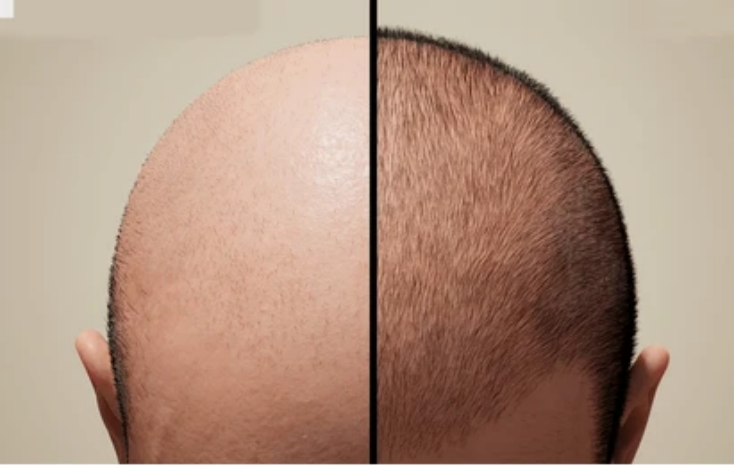
If you have been researching hair transplants, your head is probably spinning with numbers. You are reading forums where guys are bragging about getting “5,000 grafts” or asking if “3,000 grafts” is enough. It turns into a strange auction where everyone assumes the highest number wins.
But here is a hard truth that many sales-driven clinics won’t tell you: the number of grafts doesn’t matter nearly as much as how they are placed.
Imagine you are planting a forest. You could plant 5,000 trees in a perfect, straight grid, and it would look artificial. Or, you could plant 3,000 trees in irregular clusters, mimicking nature, and it would look like a dense, natural woodland. Hair restoration works the same way.
The “pluggy” look of the 1980s wasn’t caused by a lack of hair; it was caused by bad distribution. A truly great hair transplant relies on angulation and density packing. The surgeon needs to place the hairs at the exact angle your original hair grew (which changes depending on where it is on your head). They need to pack them tightly together to block the light from reflecting off the scalp.
This is why you should be wary of “hair mills” abroad that charge by the graft and promise unlimited numbers. Over-harvesting the back of your head (the donor area) can leave you with patchy, moth-eaten gaps. Your donor hair is a finite resource; once it’s gone, it’s gone. You need to use it wisely.
This conservationist approach is central to the philosophy at Transforming Lives. Their surgeons view the donor area as gold dust. They calculate exactly how many grafts are needed to achieve the visual illusion of density without depleting your bank of hair for the future. They understand that you might need a second procedure in ten years if your natural hair loss continues, so they plan for the long game.
It is also about the hairline design. A straight ruler-line hairline looks fake because nature is imperfect. A skilled surgeon will create “macro-irregularities” in the hairline—tiny dips and curves that frame the face softly.
So, when you go for a consultation, don’t just ask “How many grafts can I get?” Ask to see examples of their density work. Look at the hairlines of their previous patients. Ask about their preservation strategy.
A hair transplant is the only haircut you can’t change. It is permanent. Don’t shop for it like you are buying a TV, looking for the biggest specs at the cheapest price. Shop for it like you are commissioning a piece of art.