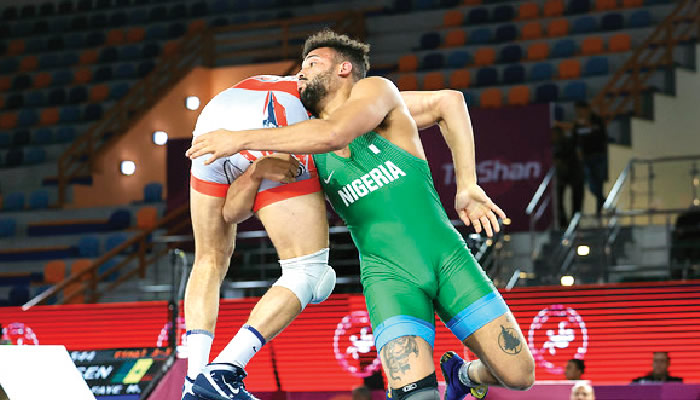
Ashton Mutuwa’s journey into the world of wrestling began in his childhood in Indiana, fueled by the spectacle of WWE. A chance encounter with a classmate sporting a wrestling-induced scratch ignited his curiosity, leading him to believe he was about to embark on a journey into the world of staged combat. Instead, he discovered folkstyle wrestling, a distinctly American variant. While his initial foray was brief, wrestling re-entered his life at 14, becoming a constant companion ever since. Mutuwa’s parents played a crucial role in nurturing his passion, providing unwavering support and chauffeuring him to practices and tournaments across the country. His mother, admittedly nervous about the sport’s physicality, often watched matches with closed eyes, while his father embraced wrestling wholeheartedly, becoming deeply invested in his son’s high school career.
Mutuwa’s early wrestling experience was marked by both precocious talent and subsequent struggles. His initial years were filled with success, but a hiatus of several years led to a period of significant challenge upon his return. He vividly recalls a season where victories were scarce, overshadowed by numerous losses. This period of adversity tested his resolve, but ultimately contributed to his growth as a wrestler and an individual. His dual citizenship, a result of his American mother and Nigerian father’s union, played a pivotal role in shaping his identity and future opportunities. Born in the US after his parents’ meeting and subsequent marriage, Mutuwa maintained close ties with his Nigerian heritage through regular visits, holding both American and Nigerian passports. This dual nationality would later open doors for him to represent Nigeria on the international stage.
Balancing the rigorous demands of academics and competitive wrestling proved a formidable task for Mutuwa. The constant travel for inter-university competitions often infringed on valuable study time, creating a challenging yet rewarding experience. It instilled in him crucial time management skills and a deep appreciation for the discipline required to excel in both domains. While he successfully navigated this balancing act throughout college, his wrestling career took a temporary pause following graduation. The limited career prospects for freestyle wrestling in the US, compared to Nigeria, led him to pursue a cybersecurity career. This decision, a common path for American wrestlers after college, reflected the realities of a system where few could sustain themselves solely through wrestling.
The allure of wrestling, however, remained strong. A conversation with a close friend, a world champion wrestler representing Serbia, ignited a new ambition: qualifying for the Olympics. This aspiration, coupled with a deep desire to reconnect with his Nigerian roots after a 15-year absence, led Mutuwa to consider representing Nigeria. This decision offered a unique opportunity to reunite with family, immerse himself in Nigerian culture, and experience the country through a new lens, beyond the sheltered visits of his childhood. It was a chance to forge deeper connections with his heritage and explore a path previously unavailable to him.
Mutuwa identifies qualifying for the Olympics as his career’s pinnacle, a testament to the dedication and perseverance required to reach the highest level of competition. While the ultimate dream remains Olympic gold, the achievement of qualification itself holds immense significance, representing the culmination of years of effort and a validation of his talent. His silver medal at the African Games in Accra, while tinged with disappointment, also served as a crucial stepping stone. Recognizing it wasn’t his peak performance, the experience highlighted areas for improvement and fueled his determination to refine his freestyle technique. This was, after all, only his second freestyle competition, a stark contrast to his extensive background in folkstyle wrestling.
Competing at the Olympics transcended personal achievement for Mutuwa. It became an opportunity to honor his heritage, represent his family, and inspire his community. His singlet, emblazoned with his name, symbolized his connection to Nigeria, his family, his hometown of Cedar Lake, Indiana, and the United States. He carried the weight of these representations with pride, recognizing the unique platform the Olympics provided to connect with a global audience and share his story. Underlying all his aspirations, however, is the fundamental principle of enjoyment. For Mutuwa, wrestling is, at its core, a source of joy and fulfillment. He believes that success stems from this intrinsic motivation and that maintaining a sense of fun is paramount in navigating the demanding nature of the sport.
Within the Nigerian wrestling camp, a distinct atmosphere prevails. A palpable sense of seriousness and commitment permeates the training environment, reflecting the athletes’ dedication to their goals. Yet, amidst the intensity, a spirit of camaraderie and shared purpose flourishes. Mutuwa recognizes the importance of balancing rigorous training with moments of levity, understanding that sustaining peak performance requires both physical and mental well-being. He admires the remarkable achievements of the Nigerian female wrestling team, acknowledging their dominance on the international stage. He draws inspiration from their success and embraces the opportunity to learn from their expertise, fostering a shared sense of growth and mutual respect within the Nigerian wrestling community.