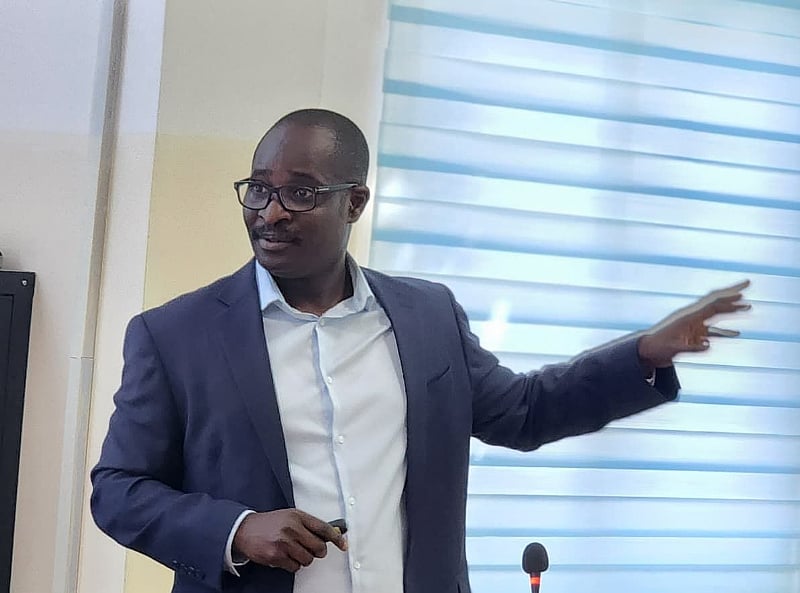
In a recent presentation at an event organized by the Public Financial Management (PFM) Tax Africa Network, Dr. Alex Annan Abakah, a respected professor at Bentley University, challenged the prevailing view that the ongoing Russia-Ukraine war significantly contributes to the depreciation of the Ghanaian cedi. His comprehensive study examined various factors influencing the currency’s decline, revealing that the conflict has had minimal impact on the cedi’s performance. In contrast, the research indicated that the COVID-19 pandemic was responsible for approximately 11% of the depreciation, yet it also noted that the cedi exhibited relative resilience during the pandemic compared to the substantial depreciation observed in the post-pandemic period. These findings prompted Dr. Abakah to emphasize that the currency’s instability is rooted in deeper structural issues within Ghana’s economy rather than being merely a consequence of external influences.
Dr. Abakah’s research further underscored a significant disparity between Ghana’s economic performance during the pandemic and the subsequent downturn, with the cedi depreciating by an alarming 104.69% post-COVID, compared to only 21.17% for the Kenyan shilling. During the period of the Russia-Ukraine conflict, the cedi’s depreciation reached 128.26%, starkly contrasting with the Kenyan currency’s decline of 25.66%. This analysis highlights that Ghana’s weak economic fundamentals are central to the pressures on the cedi, as opposed to external shocks alone. Dr. Abakah noted that the currencies of Russia and Ukraine, during the same timeframe, actually appreciated against the cedi, illustrating the necessity of focusing on Ghana’s internal economic factors to understand the reasons behind the currency’s struggles.
Examining Ghana’s fiscal policies, Dr. Abakah pointed out that the nation’s interest-to-revenue ratio, which reached 47.27% in 2022, has exacerbated the cedi’s depreciation. This ratio means that nearly half of the government’s revenue is consumed by interest payments on loans, drastically limiting available resources for essential services like infrastructure and human capital investment. Such fiscal challenges not only weaken the economy but also diminish Ghana’s capacity to respond effectively to external economic shocks, further exacerbating the currency’s instability and depreciation. This situation underscores the necessity for comprehensive reforms to fortify the country’s economic framework.
To combat the ongoing depreciation of the cedi and promote economic resilience, Dr. Abakah proposed a multifaceted approach. He stressed the need for legislative measures to enforce fiscal discipline, including the implementation of debt ceilings to align government spending with actual revenue. Additionally, he argued for prioritizing investments in infrastructure and human capital development, which are essential for generating sustainable future revenue and providing job opportunities. By harnessing the country’s natural resources to support industrialization and modernizing agriculture for both food security and economic growth, Ghana could significantly stabilize its economy and currency.
Dr. Abakah also highlighted the importance of strict regulations in the foreign exchange market to curb currency volatility, alongside measures to control the repatriation of profits by foreign companies that increase pressure on the cedi. These strategies aim not only to address immediate currency fluctuations but also to build a more robust economic system capable of withstanding future pressures. The research findings suggest that while global events can influence economic conditions, the actual impact on Ghana is significantly determined by its internal structural weaknesses, making it crucial to address these issues for long-term stability.
Echoing Dr. Abakah’s concerns, Dr. John Asafo Agyei, a Senior Fellow at the Africa Centre for Economic Transformation, reinforced the notion that Ghana’s economic fundamentals remain vulnerable due to the persistent reliance on imports and the longstanding structure of the economy, which has not evolved since independence. This dependence on external markets leaves Ghana at risk during global downturns. He indicated that Ghana must begin implementing transformative policies from 2025 onwards to strengthen its economic foundations. By promoting self-reliance and developing a resilient economic framework, Ghana can minimize its vulnerability to both external shocks and fluctuations in its currency, paving the way for a more stable and sustainable economic future.