









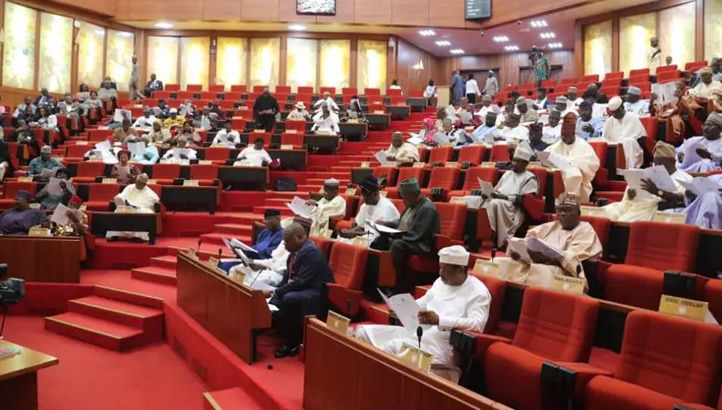
Paragraph 1: The Nigerian Senate is grappling with contentious tax reform bills, sparking debates and divisions within the National Assembly. The South-South caucus of the Senate convened an emergency meeting to solidify support for the bills, emphasizing their potential to boost national revenue and stabilize the economy. While acknowledging the need for thorough review to ensure alignment with national interests, particularly those of the South-South region, the caucus expressed commitment to supporting the reforms. They also issued a call for unity and condemned attempts to inject regional or ethnic sentiments into the national dialogue surrounding the tax reforms. Simultaneously, the caucus affirmed their confidence in Senate President Godswill Akpabio’s leadership.
Paragraph 2: Confusion erupted in the Senate chamber following conflicting directives regarding the public hearing on the tax bills. Deputy Senate President Jibrin Barau had previously instructed the Senate Committee on Finance to suspend activities related to the bills and established a special committee to liaise with the Attorney-General of the Federation (AGF). However, Senate President Akpabio subsequently denied any suspension of the public hearing, creating ambiguity around the legislative process. This discrepancy prompted the Senate Leader, Opeyemi Bamidele, to clarify that the bills, being executive bills, could only be withdrawn by the executive arm of government. He emphasized the Senate’s commitment to addressing concerns raised by the public and explained that the ad-hoc committee was formed to engage with stakeholders while the Finance Committee continued preparations for the public hearing.
Paragraph 3: The Senate leadership clarified that the tax reform bills had not been withdrawn or suspended, despite reports to the contrary. Akpabio reiterated that the bills, having passed the second reading, remained active and under consideration. The Finance Committee was tasked with conducting consultations and public hearings to gather feedback and formulate recommendations. Akpabio emphasized that the Senate conducts its work based on conscience and in the best interests of Nigerians, not through external pressures or social media. He encouraged stakeholders, including state governors, to participate in the public hearing to express their views, assuring them that the Senate would not be swayed by intimidation tactics. He highlighted the bills’ provisions aimed at benefiting a large segment of the population, such as tax exemptions for small businesses and low-income earners.
Paragraph 4: Complications arose regarding the scheduled meeting between the Senate’s special committee and the AGF. The meeting was postponed multiple times, and it eventually emerged that the AGF had not received a formal invitation from the Senate. The committee intends to send an official invitation to the AGF in the following week and aims to complete its meetings and deliberations within two weeks, after which it will submit its report to the Senate. Meanwhile, in the House of Representatives, optimism prevails regarding the eventual passage of the tax bills. However, dissenting voices, like that of Tijjani Ghali, a member representing Alabsu/Gaya/Ajingi Federal Constituency, have emerged, urging the government to abandon the bills, arguing that they would unduly burden Nigerians, especially the poor. Ghali advocated for exploring alternative revenue sources, such as the mining sector, and addressing revenue leakages instead of imposing further taxes.
Paragraph 5: The tax bills have faced significant resistance, particularly from state governors who feel bypassed in the process. An anonymous lawmaker from the North-East attributed the opposition to President Tinubu’s failure to consult with the governors through the National Economic Council (NEC) before submitting the bills to the National Assembly. The governors reportedly mobilized their representatives in the National Assembly to block the bills, signaling a potential impasse. The lawmaker suggested that a meeting between the President and the governors, or an emergency NEC meeting, could help resolve the stalemate. Furthermore, the President’s directive for the AGF to engage with the parliament on the matter has not yet been formally addressed by the House.
Paragraph 6: The House of Representatives is navigating the challenges posed by the opposition to the tax bills, particularly from members representing northern states. Despite acknowledging the bills’ merits, some lawmakers expressed concern about the political ramifications of supporting them, given the governors’ influence over their political futures. The House leadership is employing informal lobbying tactics, engaging with party and state caucuses to highlight the benefits of the proposed reforms. Kolawole Akinlayo, a member representing Ido/Osi/Moba/Ilejemeji Federal Constituency, expressed confidence in the bills’ eventual passage, attributing the opposition to a lack of understanding of their merits. He stressed the bills’ aim of achieving true federalism and implementing progressive taxation, where the wealthy contribute a larger share of their income in taxes. He emphasized the ongoing negotiations and lobbying efforts to address concerns and garner support for the tax reforms, particularly regarding the derivation component and VAT increment.









