









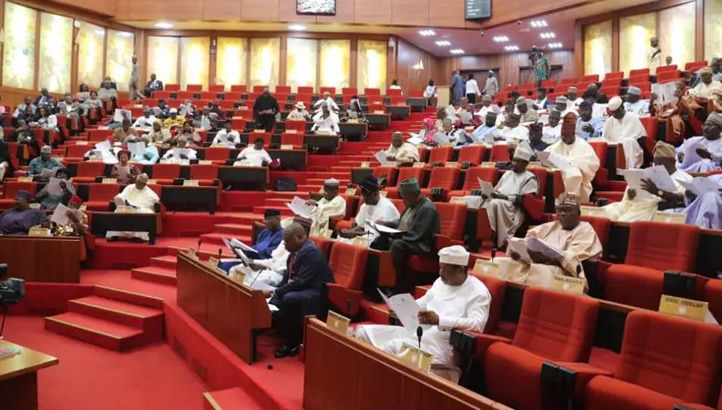
The Nigerian Senate, through its Finance Committee, has issued a strong warning to Federal Government Ministries, Departments, and Agencies (MDAs), emphasizing the importance of financial accountability and transparency. The committee has declared that any MDA failing to appear before it to account for funds allocated in the 2024 fiscal year will face severe consequences, including zero allocation in the 2025 budget. This decisive action underscores the Senate’s commitment to ensuring responsible and transparent management of public funds, aiming to curb irregularities and improve the efficiency of government spending.
The warning came during an investigative hearing focused on Internally Generated Revenue (IGR), fiscal accountability, and Nigeria’s financial management system. The committee’s dissatisfaction stems from discrepancies discovered in the financial records of several agencies, prompting a closer examination of their spending practices. Senator Sani Musa, the committee chairman, emphasized the seriousness of this performance index exercise, stating that it is a crucial precursor to the 2025 budget allocation process. He made it clear that providing comprehensive records of 2024 expenditure is a non-negotiable requirement for MDAs seeking budgetary allocations in the following year.
The Accountant-General of the Federation (AGF), Oluwatoyin Madein, presented a summary of the Federal Government’s IGR up to September 2024. The report indicated independent revenue of ₦2.7 trillion, an operating surplus from government-owned enterprises of ₦2.3 trillion, and MDAs’ IGR of ₦344 billion. However, the committee found the AGF’s report inadequate, as it primarily focused on the Accountant-General’s office and lacked a comprehensive overview of the entire Federal Government’s financial activities.
To address these shortcomings, the committee resolved to summon other relevant agencies, including the Revenue Mobilisation Allocation and Fiscal Commission (RMAFC), the Nigerian Extractive Industries Transparency Initiative (NEITI), and the Nigerian National Petroleum Corporation Limited (NNPCL). The committee believes that a joint session with these key players is essential to achieve a holistic understanding of the financial landscape and reconcile any discrepancies in reported figures. The Senate’s proactive approach signifies a concerted effort to strengthen financial oversight, enhance transparency, and build a more robust fiscal policy framework for Nigeria.
Beyond the broader issue of financial reporting, the committee also addressed critical concerns about the effectiveness of budget implementation. Members expressed significant frustration over persistent delays in releasing and utilizing capital budgets, pointing to inefficiencies within the centralized payment system managed by the AGF’s office. Furthermore, allegations of contractors being coerced into paying unofficial fees, amounting to approximately 5% of their contract value, to expedite payments have raised serious ethical and accountability questions. If substantiated, these practices represent a major flaw in the system, potentially undermining its integrity and efficiency.
The AGF’s report also revealed concerningly low stamp duty revenues from 2020 to 2024, totalling only ₦30.3 million compared to the reported ₦301 million in IGR. Lawmakers attributed this shortfall to poor budget performance, noting that taxes are effectively collected only when payments are made, linking revenue collection to the efficiency of budget execution. To facilitate further investigation and ensure accountability, the committee directed the AGF to submit all requested reports by Wednesday, December 11, 2024, in preparation for a follow-up meeting scheduled for the same day. This decisive action underscores the committee’s commitment to thorough scrutiny and its determination to hold government agencies accountable for their financial performance.









