









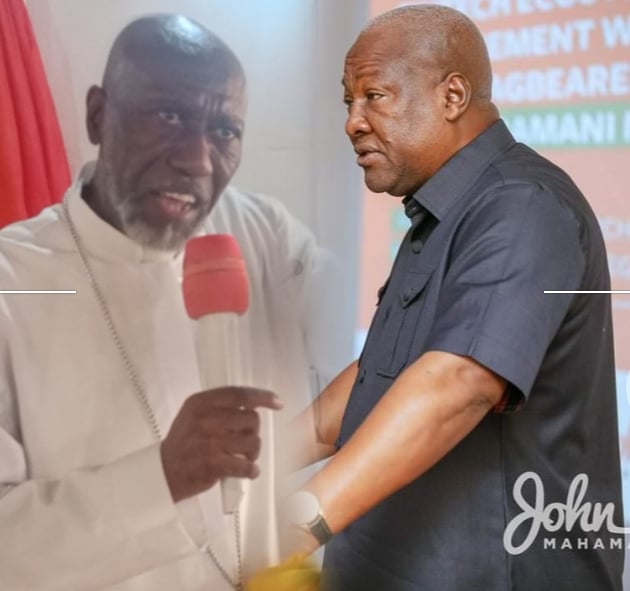
The political landscape of Ghana has witnessed a dramatic unfolding of events, marked by accusations, warnings, and spiritual pronouncements. At the center of this controversy is Prophet Owusu Bempah, leader of the Glorious Word Power Ministry, whose claims of spiritual intervention in the 2024 general elections have sparked outrage and condemnation, particularly from St. Sark, the General Overseer of Open Arms Ministry. St. Sark has vehemently denounced Owusu Bempah, labeling him a “crooked prophet,” a “confidence trickster,” a “fraudster,” and an “agent of Satan,” urging the National Democratic Congress (NDC) to sever all ties with the controversial prophet. This public denunciation serves as a testament to the deep-seated distrust and animosity that St. Sark harbors towards Owusu Bempah, stemming from what he perceives as the prophet’s deceitful and opportunistic behavior.
The crux of the dispute revolves around Owusu Bempah’s assertion that his spiritual influence played a pivotal role in securing the victory of President-elect John Dramani Mahama of the NDC. St. Sark vehemently refutes this claim, pointing to Owusu Bempah’s pre-election endorsement of Dr. Mahamudu Bawumia, the presidential candidate of the New Patriotic Party (NPP). Prior to the election, Owusu Bempah symbolically offered his pastoral seat to Bawumia during a church visit, a gesture widely interpreted as a prophetic endorsement of Bawumia’s impending victory. St. Sark argues that this act of symbolic support for Bawumia undermines Owusu Bempah’s current claims of having contributed to Mahama’s victory. He accuses Owusu Bempah of employing a “trial-and-error method” in his prophecies, suggesting that the prophet simply aligns himself with the eventual winner after the results are declared.
St. Sark has issued a stern warning to the leadership of the NDC, including John Dramani Mahama, Johnson Asiedu Nketia, Sammy Gyamfi, and Sam George, urging them to maintain a distance from Owusu Bempah. He believes that any association with the prophet would be detrimental to the party, potentially leading to their downfall. This warning underscores St. Sark’s deep-seated conviction that Owusu Bempah is a deceptive figure whose presence within the NDC could sow discord and undermine their political standing. The severity of St. Sark’s warning reflects the gravity with which he views the potential consequences of associating with Owusu Bempah.
St. Sark’s pronouncements not only highlight the contentious relationship between the two religious figures but also shed light on the complex intersection of religion and politics in Ghana. Owusu Bempah’s claims of spiritual influence in the political realm have drawn both support and criticism, with some viewing him as a genuine prophet while others dismiss him as a charlatan seeking personal gain. St. Sark’s public condemnation of Owusu Bempah represents a significant challenge to the prophet’s credibility and influence, potentially impacting his standing within the religious and political landscape. This clash of opinions underscores the ongoing debate surrounding the role of religious leaders in political affairs, particularly in a nation where religious beliefs hold significant sway.
The controversy surrounding Owusu Bempah’s prophecies also raises questions about the nature of prophecy itself and the criteria for evaluating its authenticity. St. Sark’s accusations suggest a skepticism towards prophetic pronouncements that lack consistency and appear to be driven by political expediency. He criticizes Owusu Bempah’s seemingly contradictory endorsements and his post-election attempt to align himself with the winning side. This critique raises fundamental questions about the role of prophecy in contemporary society, the potential for manipulation and misinterpretation, and the responsibility of religious leaders to uphold ethical standards in their pronouncements.
In essence, St. Sark’s public condemnation of Prophet Owusu Bempah represents a multifaceted conflict with implications for both the religious and political spheres of Ghanaian society. It highlights the ongoing tension between competing religious figures, the intersection of faith and politics, and the challenges of interpreting prophetic pronouncements in a complex and rapidly changing world. St. Sark’s unwavering stance against Owusu Bempah underscores his belief that the prophet’s actions are detrimental to both the spiritual and political well-being of the nation, serving as a cautionary tale about the potential dangers of unchecked prophetic pronouncements and the importance of discerning authentic spiritual guidance from self-serving pronouncements.









