





The Almajiri system, a traditional form of Islamic education prevalent in Northern Nigeria, has come under intense scrutiny from the Sultan of Sokoto, Alhaji Muhammad Sa’ad Abubakar. He has publicly denounced the current state of the system, characterizing it as embarrassing and requiring immediate and comprehensive reform. The Sultan’s criticism stems from the widespread practice of street begging associated with the Almajiri system, where young boys, often sent far from their homes, are left to fend for themselves, relying on alms for sustenance. This practice, the Sultan argues, is not only detrimental to the children’s well-being but also tarnishes the image of Islamic education and the community. The Sultan emphasized the need for collective responsibility in addressing this complex issue, calling upon religious leaders, community members, and government officials to collaborate on finding sustainable solutions.
The Sultan’s condemnation of the current Almajiri system is rooted in his concern for the welfare of the children involved. He expressed dismay at the conditions he witnessed during a visit to an Almajiri school, where he observed alarming levels of malnutrition among the students. Sending children away from their homes, often to distant communities, without adequate provisions for their care, is a practice the Sultan finds unacceptable. He stressed the Islamic principle of parental responsibility, emphasizing that parents are obligated to provide for their children’s physical and emotional needs. The Sultan’s critique extends beyond the issue of street begging to encompass the broader question of the quality and accessibility of Islamic education.
Reinforcing the Sultan’s condemnation, Alhaji Sani Umar Jabi, the District Head of the Gagi community, echoed the sentiment that the practice of street begging under the guise of Almajiri is un-Islamic. He emphasized that the term “Almajiri” simply refers to students of Arabic and Islamic knowledge and has no inherent connection to begging. Jabi highlighted the Islamic injunction against having more children than one can adequately care for, arguing that sending children out to beg contradicts this principle. He called for a clear distinction between seeking knowledge and exploiting children for financial gain, urging parents and guardians to uphold their religious duty to provide for their offspring. Jabi’s remarks underscored the urgent need to disentangle the genuine pursuit of Islamic education from the exploitative practices that have become associated with the Almajiri system.
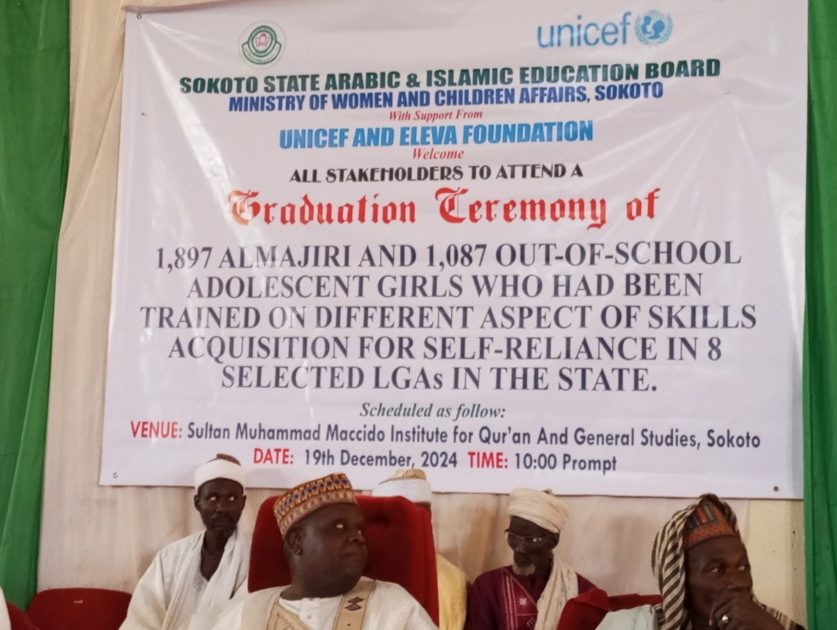
The Sokoto State government, recognizing the need for intervention, has initiated programs aimed at reforming the Almajiri system and providing alternative educational opportunities. One such program, supported by UNICEF and the Eleva Foundation, focuses on empowering Almajiri children and out-of-school adolescent girls through vocational and entrepreneurship training. The initiative aims to equip these vulnerable groups with skills that can empower them to become self-sufficient and contribute positively to society. This program reflects a growing understanding that addressing the challenges of the Almajiri system requires a multifaceted approach that goes beyond simply condemning street begging. Providing practical skills training offers a pathway for these children to break free from the cycle of poverty and dependence.
The graduation ceremony of 1,897 Almajiri and 1,087 out-of-school adolescent girls at the Sultan Maccido Institute of Quranic and General Studies marked a significant step in these reform efforts. The event showcased the potential for integrating traditional Islamic education with modern skills training, offering a model for a more sustainable and empowering system. The presentation of certificates to the graduates symbolized their accomplishment and their readiness to embark on new paths. The display of their handiwork served as a testament to their newly acquired skills and their potential to contribute to their communities. This graduation ceremony represents a beacon of hope for the future of the Almajiri system, demonstrating that change is possible and that these children can be empowered to lead fulfilling and productive lives.
The ongoing debate and reform efforts surrounding the Almajiri system underscore the complex interplay between tradition, religion, and social responsibility in Northern Nigeria. The Sultan’s outspoken criticism and the government’s proactive initiatives signal a growing recognition of the need for change. The challenge now lies in implementing sustainable solutions that address the root causes of the problem, while preserving the core values of Islamic education. The future of the Almajiri system hinges on the collective commitment of all stakeholders to work together to create a system that truly empowers children and upholds their rights to a dignified and fulfilling life. The integration of vocational training, coupled with a renewed emphasis on parental responsibility, offers a promising pathway towards a more sustainable and equitable future for the Almajiri children of Northern Nigeria.








