









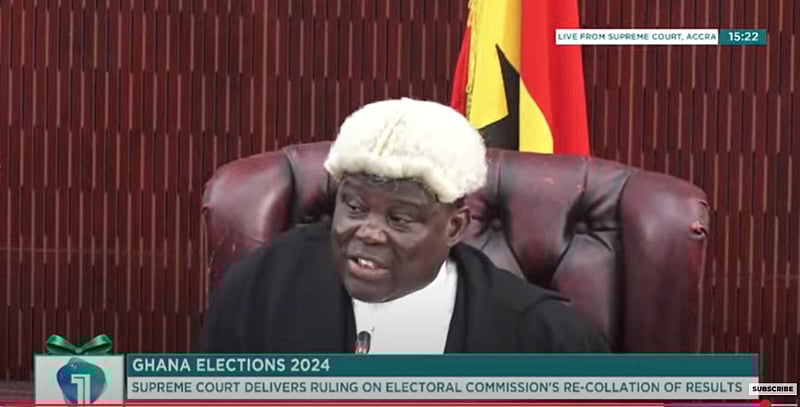
The Supreme Court of Ghana has intervened in a contentious electoral dispute, ordering a reassignment of the mandamus application filed by New Patriotic Party (NPP) parliamentary candidates to a new High Court judge. This directive aims to ensure the integrity of the judicial process following the annulment of previous orders issued by the initial judge. While the Supreme Court quashed the earlier directives, it emphasized that the core mandamus applications remain valid and must be addressed by the newly assigned judge. This decision marks a significant development in the ongoing legal battle over the parliamentary election results in nine constituencies.
The crux of the matter lies in a December 20th High Court ruling that compelled the Electoral Commission (EC) to re-collate results in the disputed constituencies following the NPP candidates’ mandamus application. This application, a legal mechanism used to compel a public official to perform a mandatory duty, was lodged by the NPP candidates contesting the election outcomes. The opposition National Democratic Congress (NDC), however, challenged the High Court’s decision, arguing that the re-collation process was unlawful and marred by procedural irregularities. This challenge prompted the NDC to escalate the issue to the Supreme Court, creating a complex legal entanglement.
The EC, adhering to the initial High Court ruling, initiated the re-collation process in seven of the nine constituencies, all of which were subsequently won by the NPP. However, the results for the Dome/Kwabenya and Ablekuma North constituencies remain unresolved, further intensifying the political and legal tensions surrounding the case. This delay contributes to the uncertainty and potential for further legal challenges, underscoring the urgency of the Supreme Court’s intervention. The unresolved results also highlight the localized nature of the dispute and the potential impact on the overall parliamentary composition.
Justice Gabriel Pwamang, delivering the Supreme Court’s ruling, clarified the court’s position, emphasizing that the annulment of the previous orders does not invalidate the underlying mandamus applications. He asserted that these applications “are still alive and ought to be heard and determined,” reinforcing the importance of addressing the substantive issues raised by the NPP candidates. The court, exercising its authority under Article 129 (4) of the 1992 Constitution and Order 55 Rule 65, granted the applicants permission to file affidavits and statements of case in response to the quashed orders. This procedural step aims to ensure a fair and comprehensive hearing of the matter before the new judge. The court also imposed an abridged timeframe of two days for the filing of these documents, reflecting the urgency of resolving the electoral dispute.
Acknowledging the time constraints imposed by the national electoral calendar, the Supreme Court mandated an expedited hearing of the mandamus applications, scheduling it for Tuesday, December 31, 2024. This directive underscores the Court’s commitment to resolving the dispute swiftly and efficiently while upholding the principles of due process. The expedited timeframe also demonstrates the significance of the case within the broader context of the electoral process and the importance of ensuring a timely resolution to maintain public confidence in the democratic system.
Addressing the allegations of bias against the initial judge, Justice Pwamang stated that the court found the evidence presented insufficient to substantiate the claims. However, to maintain the impartiality and integrity of the judicial process, the Supreme Court opted to reassign the case to a different judge. This decision, while not directly confirming bias, reflects the court’s proactive approach to ensuring public trust in the judiciary and preventing any perception of partiality. The reassignment underscores the principle that justice must not only be done but also be seen to be done. The Supreme Court’s actions aim to create a level playing field for all parties involved, fostering confidence in the fairness and objectivity of the legal proceedings.









