









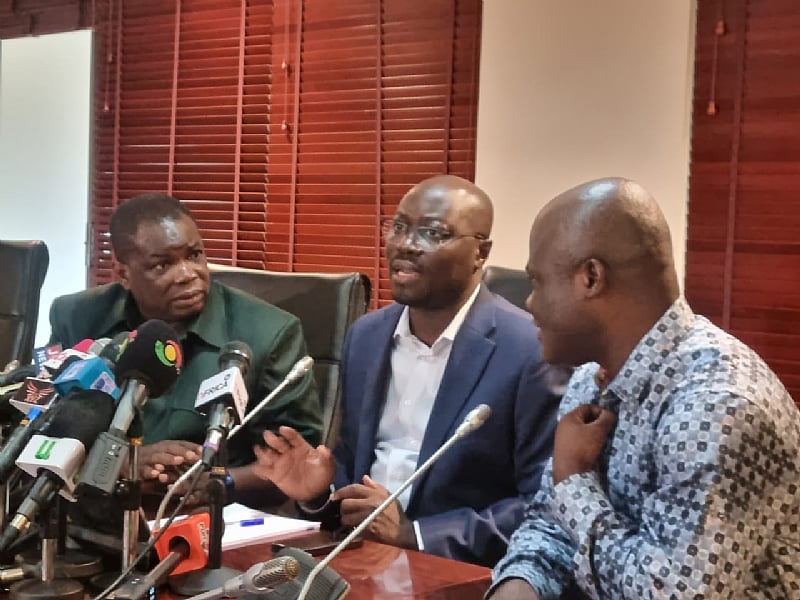
The current political landscape in Ghana has reached a boiling point as the National Democratic Congress (NDC) Caucus in Parliament asserts its stance as the Majority, despite a recent Supreme Court ruling that suspends Speaker Alban Bagbin’s declaration of four parliamentary seats as vacant. This situation has created a tense atmosphere ahead of the next parliamentary meeting scheduled for Tuesday. In a recent press conference, Dr. Ato Forson, the MP for Ajumako Enyan Esiam, expressed unwavering confidence in their position, stating that the NDC Caucus will not back down from the legality of their new status as the Majority. He underscored that the actions of the Speaker were lawful, affirming their intent to repeal certain taxes imposed by the Akufo-Addo administration, including the contentious e-Levy and the betting tax.
On the other side of the aisle, the New Patriotic Party (NPP) Caucus has demonstrated significant discontent in response to the Speaker’s ruling that they deemed unfavorable. Led by Alexander Afenyo-Markin, the MP for Effutu, the NPP Caucus staged a boycott in Parliament, insisting they would remain absent until the Supreme Court ruled on a related ex parte application. The NPP’s strategy appears to be a keen attempt to navigate the recent Supreme Court actions carefully, which have ultimately granted a Stay of Execution on the Speaker’s previous ruling regarding the parliamentary seats. This circumstance sets the stage for a fierce confrontation, where both parties strive to assert their dominance in Parliament.
The implications of the Supreme Court’s ruling cannot be overstated. Following the court’s decision on October 18, which temporarily suspended the Speaker’s ruling, it is anticipated that the NPP MPs will lift their boycott and return to Parliament, making Tuesday’s session a potential flashpoint for unresolved tensions. Both parties, representing distinctly opposed political ideologies, are now gearing up for what many observers have dubbed a ‘showdown’ in Parliament. The stakes are notably high, as each side seeks to solidify its claims over Majority status and influence the legislative agenda moving forward, particularly in light of the proposed actions to repeal taxes.
Dr. Ato Forson further reinforced the NDC’s position by stating that their claim to the Majority is not merely a political statement but a reflection of their legal standing as established by the Speaker’s authority. He articulated that the Caucus’s forthcoming actions will prioritize the repeal of certain financial burdens placed on citizens due to taxes that the NDC considers onerous. His remarks indicate a determination to not only maintain their position but also to actively reshape the fiscal landscape as part of their governing ethos. This approach seeks to galvanize public support and demonstrate their commitment to addressing economic grievances.
In parallel, the sentiments expressed by Mahama Ayariga, the MP for Bawku Central, highlight a distinct approach within the NDC. He emphasized the importance of operating within the framework of official communication from the Speaker, rather than relying on social media narratives, which he views as unreliable. His statement reflects a focus on institutional fidelity and cooperation, suggesting that their strategy is rooted in a collective approach rather than one driven by individual assertions or public opinion. This mindset may prove beneficial as the two sides gear up for an inevitable clash in Parliament, where adherence to protocol and legality will be critically under scrutiny.
As Ghana navigates this period of heightened political scrutiny, the upcoming parliamentary session is set to become a pivotal moment in determining the trajectory of political power and legislative priorities. The dual narratives emerging from the NDC and NPP Caucuses indicate a profound struggle for control and relevance in governance, as both sides prepare to advocate for their agendas amid a backdrop of judicial intervention. The outcome of this confrontation may not only influence the immediate political climate but could also have long-lasting implications for how parliamentary power dynamics are shaped in Ghana. The situation encapsulates the volatile nature of Ghanaian politics, revealing deep-seated divisions and the fragility of consensus in the face of competing party ambitions.









