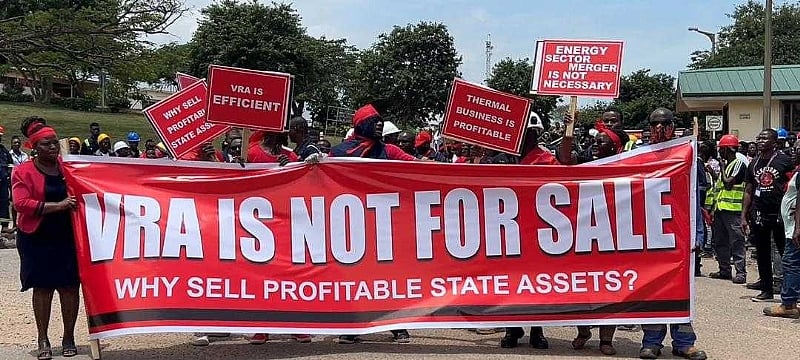
The Junior and Senior Staff Unions of the Volta River Authority (VRA) in Aboadze, Western Region, have recently staged a demonstration in response to the Ghanaian government’s planned privatization of its assets. This protest, which took place on Wednesday, underscores a growing unease regarding the direction of VRA and the larger implications for energy security within the country. Central to the government’s proposals is a draft bill aimed at merging VRA with Bui Power Authority, as well as consolidating the Electricity Company of Ghana (ECG) with the Northern Electricity Distribution Company (NEDCo). Furthermore, the bill proposes to establish an independent Thermal Power Authority, raising concerns among VRA staff who fear that these changes could jeopardize the stability of Ghana’s energy supply.
During the demonstration led by the Senior Staff Association, VRA employees adorned in red took to the streets, waving placards inscribed with messages such as “Energy sector merger is not necessary” and “VRA is not for sale.” According to Ing. James Adotey, Vice Chairman of the Senior Staff Association, the merger puts the nation’s energy stability at risk. He warned that the division of thermal plants could lead to their privatization, ultimately placing crucial energy resources into the hands of private investors. Adotey emphasized that if this materializes, it could lead to about 75% of Ghana’s energy supply being controlled by private entities, posing significant risks to national security and energy independence.
Financial indicators present a strong case for VRA’s continued operation as a state entity. Adotey highlighted that the authority declared a profit of 287 million cedis in 2023, positioning VRA as a financially stable institution rather than a government liability. The staff, however, feel disillusioned by the absence of consultation prior to the bill’s introduction. They argue that any shift towards privatizing essential energy infrastructure would have adverse effects, especially given the economic strain caused by independent power producers (IPPs) who are compensated in foreign currency. This concern amplifies as they recognize the potential repercussions for Ghana’s economy if privatization leads to inflated energy costs.
The protestors are advocating for a structured dialogue with the government, emphasizing their desire to be part of the conversation regarding VRA’s future. They assert that rather than rushing toward privatization, consultation would yield better outcomes in improving the existing systems while safeguarding energy resources. This demonstration marks the second significant protest by VRA staff, following a previous instance that failed to achieve any substantial changes. This time, a wider array of employees joined in, representing various branches of VRA, including healthcare and educational facilities associated with the authority.
Debate surrounding the government’s draft bill remains heated, with VRA staff and various stakeholders voicing strong objections to what they perceive as a risky move that could compromise national energy security. While the government asserts that privatization could lead to greater efficiency, the staff argue that VRA’s historical performance and financial health demonstrate its capacity to function effectively as a public institution. The dissent underscores the tension between the government’s vision for privatization and the employees’ commitment to maintaining a publicly controlled energy sector that prioritizes Ghana’s national interests.
As the back-and-forth continues, the potential future of VRA hangs in the balance. The staff’s commitment to ongoing protests reflects their determination to advocate for their interests and those of the wider public, indicating a deep commitment to national energy security. Meanwhile, the government pushes forward with its aims, suggesting that the debate surrounding energy privatization in Ghana is far from over. Both sides remain entrenched in their positions, leaving stakeholders to consider the potential implications for the energy landscape in Ghana should these proposed changes come to fruition.