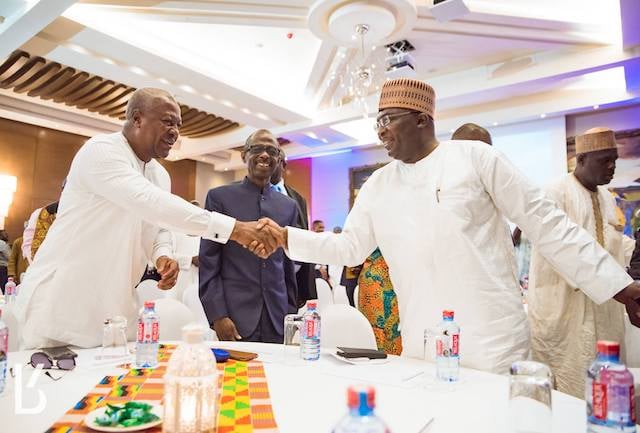
Former President John Dramani Mahama, the National Democratic Congress (NDC) candidate for the upcoming 2024 general elections, has decisively rejected calls for a public debate with Vice President Dr. Mahamudu Bawumia. During a campaign rally on October 17 in Greater Accra, Mahama expressed that debating Bawumia would be beneath his dignity and criticized the Vice President for what he termed failures in governance that he should be addressing to the Ghanaian populace instead. Mahama firmly stated, “I will not elevate Bawumia to my level by debating him,” suggesting that rather than participating in discourse, Bawumia ought to be apologizing to Ghanaians for his administrative shortcomings. This position comes in light of persistent invitations from the ruling New Patriotic Party (NPP), which has been actively encouraging Mahama to engage Bawumia on significant national issues.
The pressure for a debate has intensified, fueled not just by party officials but also by President Nana Addo Dankwa Akufo-Addo, who emphasized the need for clarity and accountability on dominant national policies like Free Senior High School (SHS) education. During an interaction with chiefs in Tamale, Akufo-Addo pointedly urged Mahama to openly confront Bawumia, stating that the Ghanaian people deserve to have a transparent discussion regarding various critical components of governance—particularly concerning the reliability and consistency of policies under scrutiny. The President’s remarks included pointed questions regarding Mahama’s stance on Free SHS, challenging him to clarify how he would approach this issue if reelected. Mahama responded sarcastically, implying that the President’s understanding of his position would become clearer once he was more alert, accentuating the tension between the two political figures.
Further complicating matters, Mahama utilized the campaign rally to address the subject of illegal mining, popularly referred to as galamsey, which has become a pressing national crisis. He asserted that his viewpoint on the galamsey issue has remained constant and referenced a prior speech he delivered at the University of Mines and Natural Resources in Sunyani. By directing attention to this earlier address and calling for the President to refer back to his comments, Mahama sought to reinforce his consistency and credibility on the matter, further asserting himself as a knowledgeable candidate in the race. His criticisms come at a time when illegal mining has sparked substantial debate about governance and resource management in Ghana, showcasing Mahama’s attempt to align his campaign with the public’s concerns.
The backdrop against which these debates unfold is significant. The discordant voices from both the NPP supporting Bawumia and the NDC backing Mahama exemplify the deep political divisions in Ghana as the December 2024 elections draw closer. Dr. Bawumia, as the NPP’s presidential candidate, alongside other party members, has been vocal in his desire for Mahama to take part in a public policy discussion. However, the NDC has consistently declined these requests, bolstered by the conviction that Mahama’s past performance as President speaks for itself. The party’s leadership maintains that engaging in debate with Bawumia—a candidate relatively new to the presidential race—would yield little benefit for Mahama, thus justifying their repeated refusals.
Additionally, it is intriguing that the calls for a concrete debate reflect a broader quest for political accountability and transparency in the political landscape of Ghana. With critical developmental issues at stake, such as the economy and education policy, the desire for public dialogue is understandable. The Ghanaian electorate is demanding clarity from the candidates as they head into an election cycle laden with promises and challenges. This underscores an important aspect of the ongoing political narrative—voters are seeking assurances from their leaders that resonate with their experiences and expectations, something Mahama’s dismissive attitude towards Bawumia’s calls for debate does not necessarily address.
In conclusion, Mahama’s steadfast stance against participating in a debate with Bawumia encapsulates the charged atmosphere leading up to the 2024 elections. His refusal is indicative of a strategic decision to maintain distance from a direct confrontation with a relatively new candidate while focusing on his party’s narrative of past accomplishments and a commitment to addressing pertinent national issues. As political dynamics continue to evolve, the implications of these positions will undoubtedly shape Ghana’s electoral landscape in the months ahead, fueling ongoing discussions about governance, accountability, and the future direction of the nation.