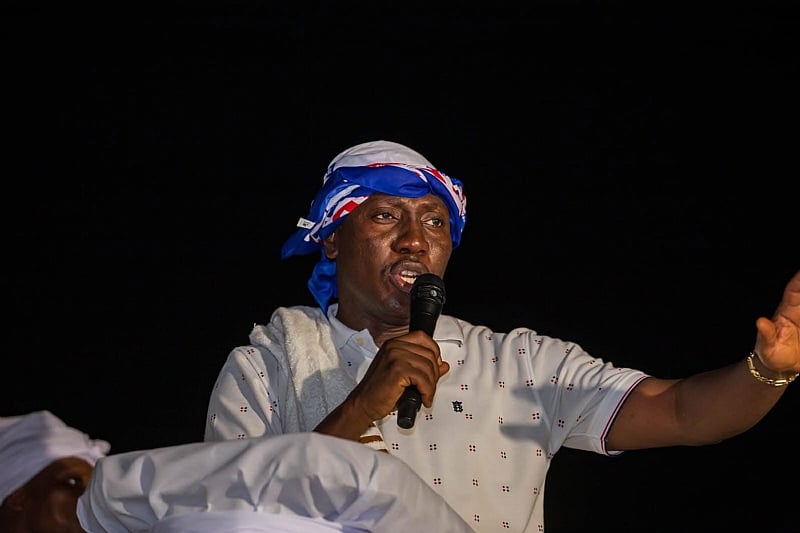
The New Patriotic Party (NPP), having conceded defeat in the 2024 general elections, has expressed its commitment to serving as a robust and responsible opposition. Alexander Afenyo-Markin, the outgoing Majority Leader and Member of Parliament for Effutu, articulated this commitment, emphasizing the NPP’s intention to hold the incoming National Democratic Congress (NDC) government accountable while adhering to democratic principles. He congratulated the NDC on their victory and assured the nation that the NPP’s opposition would be characterized by constructive engagement, devoid of disruption, violence, or chaos. Their focus, he stated, will be on rigorous scrutiny of government policies and actions, operating within the legal framework and engaging in reasoned debate to offer alternative perspectives and solutions.
Afenyo-Markin’s statement reflects the NPP’s acceptance of the electoral outcome, which saw John Dramani Mahama declared president-elect with 56.55% of the valid votes cast. The NDC also secured a significant parliamentary majority, exceeding 180 seats and relegating the NPP to a minority position with approximately 80 seats. This represents a substantial shift in the political landscape, contrasting sharply with the NPP’s commanding majority of 169 seats in the seventh Parliament and the subsequent hung parliament with a slim majority in 2020. Afenyo-Markin acknowledged this dynamic, framing it as a natural part of the democratic process and an opportunity for the NPP to reflect and regroup.
The NPP’s transition to the opposition benches marks a significant turning point for the party. Having held the reins of power for the preceding years, they now face the challenge of adapting to a new role, one that requires a different set of strategies and priorities. Afenyo-Markin’s emphasis on constructive engagement and adherence to democratic principles suggests a desire to move away from potentially divisive or disruptive tactics. This approach could be crucial for maintaining political stability and fostering a healthy democratic environment in Ghana. It also signals a recognition of the need to regain public trust and support in preparation for future elections.
The NPP’s immediate task will be to consolidate its position as the primary opposition party and effectively articulate its alternative vision for the country. This will involve scrutinizing government policies, proposing alternative solutions, and holding the NDC accountable for its promises and performance. Afenyo-Markin’s statement suggests that the NPP intends to adopt a data-driven, evidence-based approach, focusing on reasoned arguments and constructive criticism rather than resorting to populist rhetoric or disruptive tactics. This strategy could be instrumental in shaping public discourse and influencing policy decisions, even from a minority position.
Beyond its role as a watchdog, the NPP will also need to engage in introspection and self-assessment. Afenyo-Markin’s call for the party to “take stock, look at where we got it wrong, and correct our mistakes” underscores the importance of learning from the electoral defeat and adapting to the changing political landscape. This process of reflection and renewal will be crucial for rebuilding the party’s base, attracting new supporters, and developing a compelling platform for the 2028 elections. It will require addressing internal divisions, fostering unity within the party ranks, and articulating a clear and inspiring vision for the future.
The NPP’s future success will depend on its ability to effectively navigate this transition to the opposition benches. By embracing constructive engagement, adhering to democratic principles, and engaging in a thorough process of self-reflection, the party can position itself as a credible alternative to the ruling NDC and prepare for a return to power in the future. The coming years will be a test of the NPP’s resilience, adaptability, and commitment to the democratic process. The party’s ability to learn from its mistakes, rebuild its base, and articulate a compelling vision for the future will determine its long-term prospects in Ghanaian politics.