





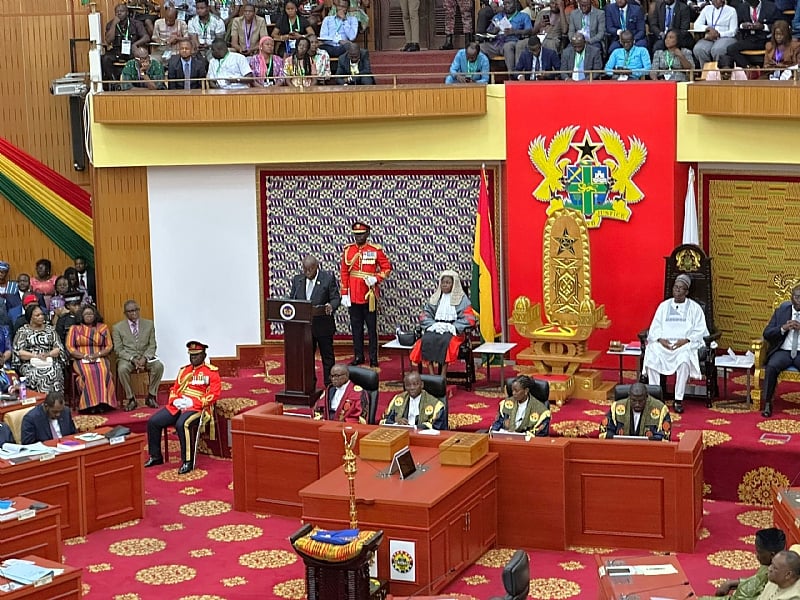
President Nana Addo Dankwa Akufo-Addo, in his State of the Nation Address, underscored the government’s commitment to bolstering Ghana’s judicial system through extensive reforms aimed at enhancing both its capacity and accessibility. He emphasized the unprecedented investment in infrastructure, citing the construction of 100 courthouses, 90 of which are already operational, as a landmark achievement in the judiciary’s history. This initiative addresses the long-standing challenge of inadequate physical infrastructure, creating a more conducive environment for the administration of justice and improving access for citizens across the country. The President portrayed this investment not merely as a construction project but as a vital step towards strengthening the rule of law and ensuring equitable access to justice.
Furthermore, President Akufo-Addo highlighted the establishment of the Court of Appeal complex in Kumasi, accompanied by twenty townhouses and a guest house for justices serving the Northern Sector. This strategic move decentralizes the appellate process, allowing appeals from eleven regions to be handled locally, thus significantly reducing delays and bringing justice closer to the people. The President noted that this decentralization not only alleviates the burden on the Accra-based Court of Appeal but also promotes efficiency and fairness in the judicial system. It reflects a broader commitment to equitable regional development and access to essential services, ensuring that all citizens, regardless of location, have access to timely and effective judicial remedies.
The President also lauded the implementation of the e-justice system, a transformative initiative that has digitized case management and streamlined various legal processes. This digitalization drive has brought about greater transparency, efficiency, and accountability within the judiciary. The e-justice system facilitates online access to case information, electronic filing of documents, and virtual court hearings, significantly reducing the time and cost associated with traditional paper-based processes. President Akufo-Addo emphasized the importance of this technological advancement in modernizing the judicial system, making it more responsive to the needs of citizens in the digital age and strengthening its role as a cornerstone of Ghana’s democratic governance and development.
Further strengthening the capacity of the judiciary is the completion of the Law House, a state-of-the-art facility that houses the Office of the Attorney General. The President highlighted this development as a crucial step towards enhancing the effectiveness and efficiency of the Attorney General’s office, which plays a vital role in legal representation, prosecution, and advisory services to the government. The modern facilities and resources available in the Law House enable the Attorney General’s office to discharge its duties with greater professionalism and effectiveness, contributing to the overall improvement of the justice delivery system.
These comprehensive reforms undertaken by the government, according to President Akufo-Addo, demonstrate a firm commitment to strengthening the rule of law and enhancing access to justice for all Ghanaians. By investing in infrastructure, technology, and human capital, the government aims to create a robust and efficient judicial system that can effectively address the needs of a modernizing society. The president emphasized the interconnectedness of these reforms, portraying them as a holistic approach towards building a just and equitable society.
In conclusion, President Akufo-Addo’s address painted a picture of significant progress in strengthening Ghana’s judiciary. From physical infrastructure improvements to technological advancements and capacity building, the reforms aim to make the judicial system more efficient, accessible, and responsive to the needs of the citizenry. The investments made underscore the government’s recognition of the judiciary’s crucial role in upholding the rule of law, fostering economic development, and promoting democratic values within the country. The President’s emphasis on these achievements signals a commitment to continuing these efforts to ensure a just and equitable society for all Ghanaians.








