





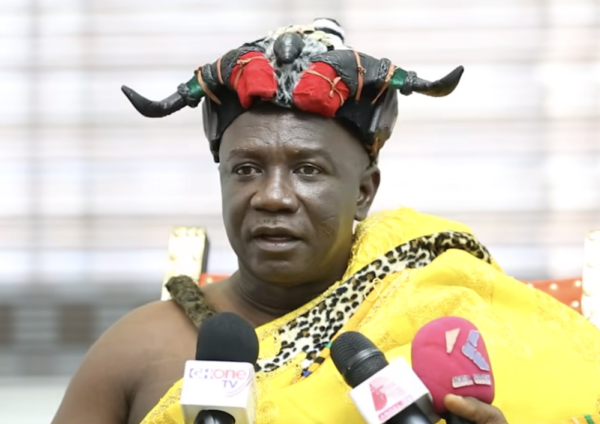
Nana Boadi Amponim Abodade III, Krontihene of Akyem Asoum, has publicly expressed his disillusionment with the outgoing President Nana Addo Dankwa Akufo-Addo’s administration and declared his support for the incoming President, John Dramani Mahama. In a candid interview, the traditional leader articulated his belief that Akufo-Addo’s presidency, despite having access to significant resources and revenue, fell short of its potential. He conveyed a sense of relief at the end of Akufo-Addo’s term, contrasting it with a hopeful anticipation for Mahama’s return to power, framing it as a necessary intervention to heal a nation he described as “stripped naked and bleeding.”
A central theme of Nana Abodade III’s critique was the perceived mismanagement of national resources under Akufo-Addo’s leadership. He likened the outgoing administration to robbers who have plundered the nation’s wealth, leaving it vulnerable and impoverished. In this metaphor, Mahama is cast as the “good Samaritan” from the biblical parable, arriving to rescue and restore Ghana to health and prosperity, and crucially, to recover the misappropriated resources. This characterization underscores the Krontihene’s deep dissatisfaction with the perceived economic performance of the previous administration and his faith in Mahama’s ability to rectify the situation.
The Krontihene didn’t limit his criticism to economic matters. He also censured what he considered to be Akufo-Addo’s disrespectful treatment of traditional chiefs. He recounted an anecdote shared by a fellow chief, highlighting an alleged incident where the President expected chiefs to rise and greet him, a gesture interpreted as a slight against their traditional authority. This anecdote served to illustrate a broader pattern of perceived disrespect, painting a picture of strained relations between the presidency and the chieftaincy. This alleged disregard for traditional authority further solidified the Krontihene’s negative assessment of Akufo-Addo’s leadership style.
Furthermore, Nana Abodade III underscored the widespread nature of this dissatisfaction, claiming that many other chiefs shared his sentiments. He presented his own perspective not as an isolated case, but as representative of a broader feeling within the chieftaincy. By suggesting that numerous chiefs quietly welcomed the end of Akufo-Addo’s tenure, he amplified the weight of his criticism, portraying it as a reflection of collective disappointment rather than a singular opinion. This assertion of shared sentiment underscores the potential political implications of such discontent within influential traditional leadership circles.
The Krontihene’s statement was imbued with a sense of lost potential. He repeatedly emphasized the significant resources available to Akufo-Addo’s administration, arguing that these could have been leveraged to achieve far greater progress for the nation. This repeated emphasis on the available resources underscores the Krontihene’s belief that the outgoing administration failed to capitalize on a unique opportunity to drive development and improve the lives of Ghanaians. He concluded his critique with a fervent hope that Ghana would never again have a president like Akufo-Addo, a statement that encapsulates his profound disapproval of the outgoing president’s leadership.
In summary, Nana Boadi Amponim Abodade III’s outspoken critique of the outgoing president encompassed not only economic performance but also the alleged disrespectful treatment of traditional leaders. He positioned Mahama as a beacon of hope for restoring the nation’s fortunes and repairing the perceived damage inflicted during Akufo-Addo’s tenure. His strong words, combined with the claim of widespread dissatisfaction among chiefs, signal a potentially significant shift in the political landscape and highlight the importance of traditional leadership in Ghanaian politics. His concluding prayer against a similar presidency in the future underscores the depth of his disillusionment and serves as a stark warning to future leaders about the importance of respecting traditional authority and effectively utilizing national resources.








