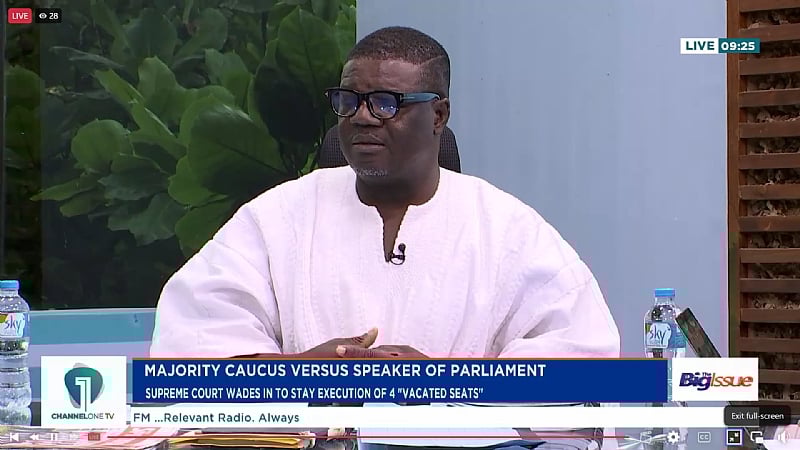
Rockson-Nelson Dafeamekpor, the Member of Parliament representing South Dayi, has raised significant concerns regarding the Electoral Commission’s (EC) recent disqualification of Joana Gyan Cudjoe, who is the parliamentary candidate for the National Democratic Congress (NDC) in Amenfi Central. The disqualification occurred on October 16, with the EC specifying a pending injunction related to NDC’s primary election as the basis for their decision. Dafeamekpor has challenged the decision, arguing that the EC lacks the legal authority to disqualify a candidate based solely on this injunction, which he asserts was resolved prior to the EC’s announcement. His comments were made during an interview with Selorm Adonoo on Channel One TV’s “Big Issue” on October 19.
Dafeamekpor firmly believes that the responsibility to declare a candidate ineligible lies solely with the judiciary, as codified in electoral law. He accused the EC of overstepping its jurisdiction and questioned the legitimacy of the letter that formally communicated Cudjoe’s disqualification. He stated, “The EC has acted beyond its powers,” emphasizing that disqualifying a candidate due to an injunction that has been overturned does not fall within the EC’s jurisdiction. Dafeamekpor demanded that the EC provide a legal basis for their decision, asserting that their actions could undermine the democratic process by preventing lawful candidates from contesting elections.
The basis of the EC’s disqualification letter cites a “pending injunction” that allegedly prevents Joana Cudjoe from representing herself as the NDC’s parliamentary candidate. However, Dafeamekpor contested this point by highlighting that the injunction was linked to an election that has already been annulled. He expressed confusion over the timing of the EC’s letter, which emerged unexpectedly on October 10, and reiterated that the existence of a pending injunction does not inherently disqualify a candidate from eligibility to contest in elections. He argued that the resolution of such matters should remain with the court system, and until a definitive judicial ruling is made, the EC should not impede a candidate’s ability to participate in elections.
Dafeamekpor further elucidated that if a court ultimately deems a candidate ineligible, the EC retains mechanisms to address the situation post-election through processes like by-elections. “You allow the matter to be determined by a court,” he stated, emphasizing the importance of due legal process. He added that should a court determine an individual is unfit for candidacy after the elections, the EC is well-positioned to rectify the issue rather than preemptively disqualifying candidates based on unresolved judicial matters.
The South Dayi MP’s remarks highlight a complicated intersection between electoral regulations and judicial authority in Ghana’s political landscape. His robust defense of Cudjoe’s candidacy calls into question the autonomy and decision-making processes within the EC. He maintained that the commission’s recent actions could set a dangerous precedent for future elections, as this instance suggests an erosion of the checks and balances intended to protect candidates’ rights within the electoral framework.
This ongoing dispute raises critical questions surrounding the role of the Electoral Commission in regulating elections and the extent of its authority in matters concerning candidate eligibility. Dafeamekpor’s challenges reveal the tensions that exist between political parties and electoral bodies, and emphasize the importance of adhering to legal protocols that safeguard democratic processes. As the December elections approach, the resolution of this issue could significantly impact both the NDC and the broader electoral landscape in Ghana.