





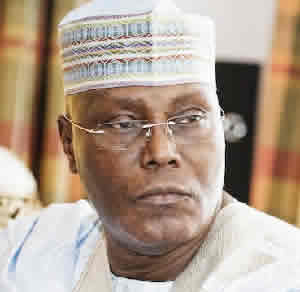
Atiku Abubakar, the 2023 presidential candidate of the Peoples Democratic Party (PDP), has launched a scathing critique of President Bola Tinubu’s proposed 2025 budget, characterizing it as a continuation of the unsustainable borrowing practices that plagued the previous administration of Muhammadu Buhari. Atiku argues that the N47.9 trillion budget, while ambitious in its spending targets, lacks the necessary structural reforms and fiscal discipline to effectively address Nigeria’s complex economic woes. He contends that the budget’s heavy reliance on borrowing will further exacerbate the nation’s debt burden and hinder its economic prospects, echoing the very pitfalls that have characterized the APC’s governance since 2016. Instead of offering a path to sustainable growth, Atiku asserts that the budget merely perpetuates the cycle of deficits and debt accumulation.
Central to Atiku’s criticism is the budget’s projected deficit of N13 trillion, representing 4% of the country’s GDP. This deficit is to be financed through over N13 trillion in new borrowings, comprised of N9 trillion in direct loans and N4 trillion in project-specific financing. Atiku argues that this dependence on borrowing mirrors the failed strategies of past administrations and will only serve to increase the nation’s public debt, placing a significant strain on resources due to rising interest payments and exposure to foreign exchange fluctuations. He highlights the alarming fact that N15.8 trillion, a staggering 33% of the total expenditure, is allocated to debt servicing, nearly equaling the N16 trillion earmarked for capital expenditure (34%). This stark imbalance, Atiku warns, will stifle essential investments and further entrench the cycle of borrowing.
Furthermore, Atiku expresses deep concern about the government’s recurrent expenditure, which stands at over N14 trillion, or 30% of the budget. He attributes this high recurrent expenditure to an overly large and inefficient bureaucracy and the continued operation of unproductive public enterprises. This leaves a disproportionately small allocation for crucial development projects, further hindering Nigeria’s progress. He contrasts this with the capital expenditure allocation, which, after accounting for debt servicing and recurrent costs, amounts to a mere 25% to 34% of the total budget. This, Atiku asserts, is woefully inadequate to address Nigeria’s significant infrastructure deficit and stimulate meaningful economic growth. Calculated on a per capita basis, the capital allocation translates to roughly N80,000 (approximately $45) per person, a paltry sum for a nation struggling with sluggish economic growth and underdeveloped infrastructure.
Adding to his critique, Atiku points to the underperformance of the 2024 budget, which achieved less than 35% disbursement for capital expenditure allocated to ministries, departments, and agencies by the third quarter, despite claims of 85% implementation. This, he argues, raises serious doubts about the government’s capacity to effectively execute the ambitious spending plans outlined in the 2025 budget. The proposed increase in the VAT rate from 7.5% to 10% draws further criticism from Atiku, who describes it as a regressive measure that will disproportionately burden the already struggling populace, escalating the cost of living and ultimately hindering economic growth. He argues that imposing additional taxes without addressing fundamental inefficiencies in governance is counterproductive and will stifle domestic consumption, exacerbating economic hardship.
Atiku advocates for a fundamental shift towards disciplined and growth-oriented fiscal policies. He emphasizes the urgent need to curb wasteful spending, improve the efficiency of public expenditure, and prioritize investments in strategically crucial sectors. Instead of relying on unsustainable borrowing practices, Atiku calls for a focus on long-term fiscal sustainability and genuine economic growth. He urges the administration to reconsider its borrowing strategy and implement comprehensive reforms that address the root causes of Nigeria’s economic challenges. Instead of perpetuating a cycle of debt and deficits, Atiku advocates for a more prudent and sustainable approach to fiscal management, one that prioritizes long-term economic prosperity over short-term spending sprees.
In essence, Atiku’s critique paints a picture of a budget that, while seemingly ambitious, lacks the necessary structural foundation to deliver meaningful and sustainable economic progress. He argues that the budget’s reliance on borrowing, coupled with high recurrent expenditure and inadequate capital investment, will only serve to exacerbate existing economic challenges, further hindering Nigeria’s development trajectory. He calls for a paradigm shift in fiscal policy, emphasizing the need for fiscal discipline, efficient resource allocation, and a genuine commitment to long-term economic sustainability. His concerns underscore the need for a more rigorous and strategic approach to budgeting, one that prioritizes structural reforms and lays the groundwork for genuine and inclusive economic growth.








