The landscape of football has dramatically changed with the absence of two of its greatest icons, Lionel Messi and Cristiano Ronaldo, from the 2023 Ballon d’Or shortlist. This marks a significant milestone as it is the first time since 2003 that neither player is vying for this prestigious award, which they have collectively won 13 times. Messi’s remarkable eight victories include consecutive wins from 2009 to 2012, a testament to their long-standing dominance in the sport. Despite some signs that this era was potentially ending as early as 2021, with Messi missing the shortlist and Ronaldo’s poor ranking, Messi’s resurgence in 2022—where he clinched his eighth award following Argentina’s World Cup victory—defied the anticipated transition. The changing of the guard is now palpable, leaving the footballing world to explore the burgeoning talent that could have claimed the Ballon d’Or if not for the relentless brilliance of Messi and Ronaldo.
Historically, numerous players have found themselves overshadowed by the two superstars, stymied in their pursuit of football’s highest individual accolade. The anticipation of different potential winners has always been muted by the presence of these giants, particularly during the years when accolades and trophies were exchanged between them almost predictably. For instance, the cancellation of the award in 2020 opened a peculiar gap but did not lessen the weight of Messi and Ronaldo’s legacies. This narrative juxtaposes some of the game’s notable talents—whose stellar performances would have potentially vaulted them into Ballon d’Or contention—against the backdrop of Messi’s and Ronaldo’s remarkable achievements.
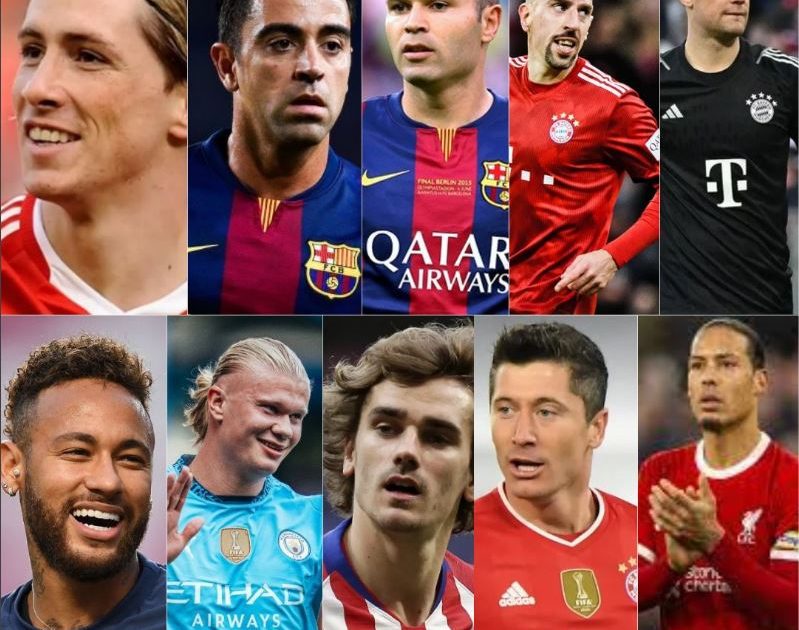
Among these notable figures is Fernando Torres, who in 2008 excelled as a striker for Liverpool and Spain. His 26 goals helped propel Liverpool and, notably, Spain to glory in Euro 2008, yet he finished third in the Ballon d’Or voting, largely eclipsed by the contest between Messi and Ronaldo. Similarly, Xavi and Andres Iniesta from Barcelona had strong claims to the award during the apex of their careers. Xavi’s contributions, particularly in 2009 and 2011, saw him finish third behind Messi, who was continually recognized for his extraordinary scoring feats. Iniesta, with pivotal performances in both club and international competitions, watched Messi claim the award again in 2012, despite being vital to Spain’s World Cup victory.
The landscape continues with players like Franck Ribery and Manuel Neuer, who both experienced their near misses for the Ballon d’Or in 2013 and 2014 respectively. Ribery’s triumphant season with Bayern Munich, where he played a key role in their historic treble-win, placed him in strong competition, but Ronaldo’s performances in World Cup qualifiers propelled him to victory. Likewise, Neuer’s excellence in goal at the club level and during Germany’s World Cup win should have made him a serious contender; however, Ronaldo’s hold on the title remained firm as he continued to deliver stellar performances for Real Madrid.
The narrative of players falling short of Ballon d’Or glory continues with Neymar, who in 2015 and 2017 produced stunning performances, yet still found himself overshadowed, finishing third behind the dominant duo. Antoine Griezmann’s 2016 accomplishments also fell short. Having spearheaded both Atletico Madrid and the French national side to crucial finals, he still could not surpass Ronaldo’s remarkable achievements that year. Virgil van Dijk’s incredible defensive work for Liverpool in 2019 nearly secured him the award but again fell just shy as Messi once again took home the accolade. Furthermore, Robert Lewandowski’s phenomenal scoring record in 2021 echoed the frustrations of many fans who felt his achievements warranted recognition, with Messi even calling for his retrospective acknowledgment of the 2020 award.
Erling Haaland embodies the new wave of talent that has emerged in this shifting football landscape. In 2023, he delivered a record-breaking performance, scoring 64 goals for Manchester City, leading to speculation about his potential Ballon d’Or victory. However, similar to his predecessors, Haaland was unable to extend beyond Messi’s shadow, with the Argentine legend’s triumphant World Cup run sealing his eighth award. This spectrum of talent showcases how individuals have continuously pushed boundaries in their performances, yet the shadow cast by Messi and Ronaldo often rendered their extraordinary successes insufficient to claim the individual honor that eluded them for so long.
As we mark this transition into a new era without Messi and Ronaldo as contenders, the reflected histories of players unable to navigate around their dominance serve as both an acknowledgment of their extraordinary legacies and a heralding of opportunities for the next generation of football stars. The Ballon d’Or, for so long a mere footnote in the careers of many talented players, remains a coveted prize eagerly awaited, with the anticipation now shifting towards a fresh competitive narrative. Each candidate coming forward will now seek to capitalize on this jarring absence, offering a new chapter in a sport defined by both history and progress, as football enthusiasts everywhere await to see who will rise to the fore in what promises to be an intriguing phase in the world of football.