









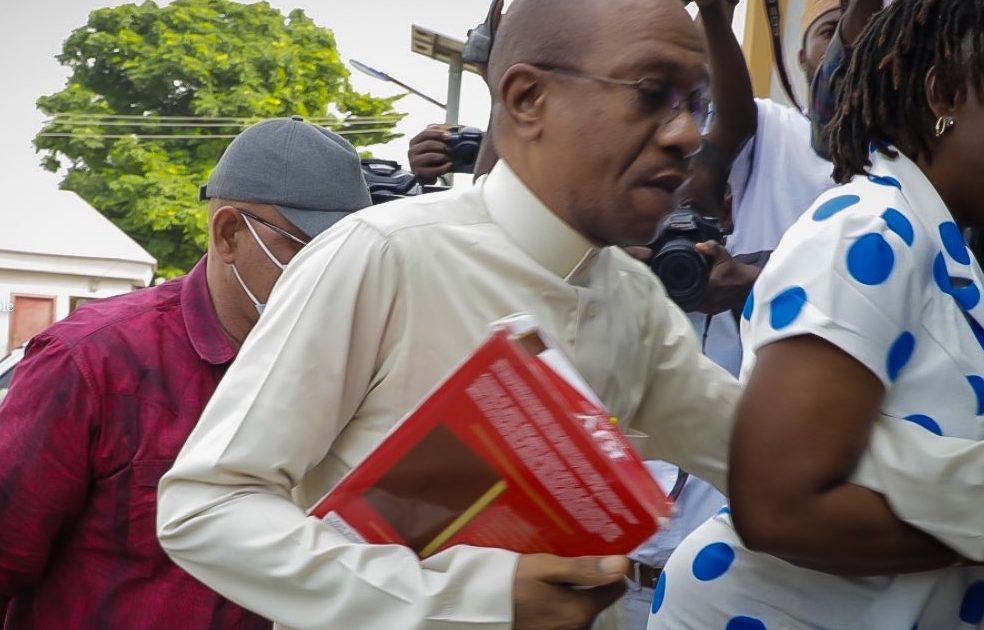
The Federal High Court in Lagos has made a significant ruling concerning former Central Bank of Nigeria (CBN) governor Godwin Emefiele, ordering the permanent forfeiture of assets totaling $2.045 million, seven high-value properties, and associated share certificates. This decision, rendered by Justice Deinde Dipeolu, follows an earlier interim forfeiture that went uncontested by either Emefiele or any interested parties. The court’s ruling entails that these funds and assets, linked to the Queensdorf Global Fund Limited Trust, will be permanently handed over to the Federal Government of Nigeria. The ruling underscores the seriousness with which the court approaches the issue of wealth acquisition, particularly when it is suspected to stem from unlawful activities.
The court’s decision to forfeit the seven properties stems from Emefiele’s failure to provide evidence supporting that his earnings from Zenith Bank and the CBN were used to acquire them. Justice Dipeolu argued that Emefiele did not present adequate documentation that could establish legitimate ownership or income provenance for these assets. Instead, the former CBN governor maintained that he had no ties to the companies from which the properties were allegedly acquired, creating a lack of accountability regarding the ownership claims made on his behalf. The absence of claims from the companies involved further complicates the narrative, leading the court to question the legitimacy of these assets.
In arriving at the conclusion to forfeit Emefiele’s properties permanently, the presiding judge expressed suspicion over the legitimacy of the asset acquisition process. Justice Dipeolu noted that the failure of Emefiele and the associated companies to produce credible evidence raised concerns about the possibility of illicit activity in securing these properties. The judge posited that the lack of lawful interest or justification provided by Emefiele hints at an underlying attempt to obscure how the properties were obtained. Consequently, he ordered that all properties in question be forfeited to the Federal Government, reflecting a broader effort to tackle corruption and financial mismanagement in Nigeria.
The properties being forfeited include luxury real estate located in prominent areas of Lagos, such as duplexes in Lekki and Ikoyi, and an industrial complex in Delta State. This list exemplifies the caliber of assets tied to Emefiele, showcasing both his financial standing and the magnitude of his former position as CBN governor. The properties, some of which are still under development, represent substantial economic value, further emphasizing the court’s commitment to addressing the potential misuse of public funds and assets linked to high-ranking officials.
Additionally, the Economic and Financial Crimes Commission (EFCC) had previously identified several companies associated with Emefiele, including Amrash Ventures Limited and Modern Hotels Limited, which were implicated in the acquisition of the forfeited assets. The inability of these companies to assert their ownership rights during the legal proceedings only intensified scrutiny on Emefiele and heightened suspicions regarding the origins of the funds used to procure the properties. The court’s ruling not only reinforces the enforcement of regulatory frameworks but also signals a potential paradigm shift in how financial crimes are addressed by authorities in Nigeria.
The EFCC first secured an interim order for the seizure of Emefiele’s assets back in August 2024, highlighting a proactive stance against financial impropriety. With the permanent forfeiture now established, it paves the way for increased oversight and accountability measures aimed at public officials and their wealth accumulation practices. The ruling serves as a crucial reminder of the potential legal repercussions for engaging in corruption or financial misconduct in Nigeria, while also encouraging a culture of transparency and ethical conduct within government institutions. Justice Dipeolu’s decision thus represents a landmark moment in the ongoing battle against corruption within the country, potentially setting precedence for future cases.









