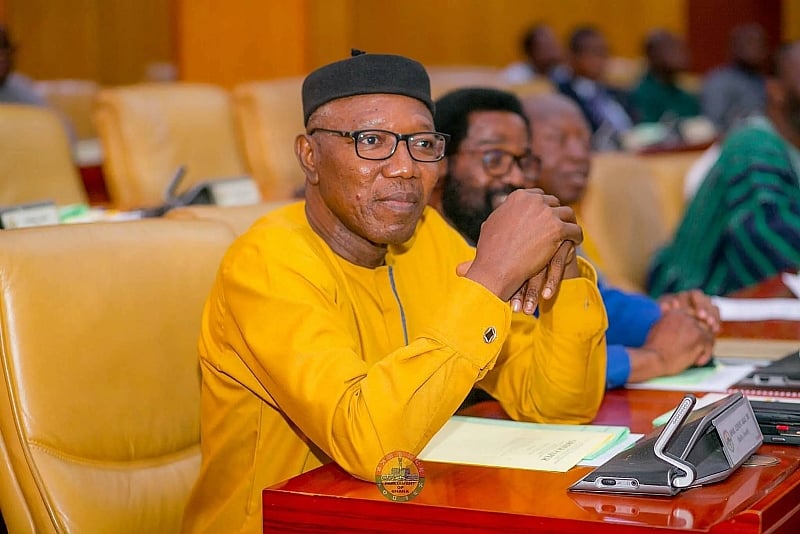
Dr. Clement Apaak, the Member of Parliament for Builsa South, has attributed the significant depreciation of Ghana’s currency, the cedi, against major global currencies to the New Patriotic Party’s (NPP) flag bearer, Dr. Mahamudu Bawumia. This assertion follows remarks made by Dr. J. K Kwakye, the Director of Research at the Institute of Economic Affairs (IEA), who expressed that the cedi’s current state is embarrassing to the country’s economists and that they have failed the Ghanaian populace. Dr. Kwakye lamented the steep depreciation of the currency, which now costs approximately Ghc16 to one US dollar and Ghc20 to one British pound, and questioned how much more of this financial turmoil Ghanaians should endure.
In light of the concerns raised by Dr. Kwakye, Dr. Apaak responded by holding the NPP and its representatives accountable for the economic downturn. He emphasized that the entire NPP administration has failed across various sectors, suggesting that Ghanaians must vote them out. Dr. Apaak pointedly directed his criticisms toward Dr. Bawumia, nicknamed ‘DMB’, urging Dr. Kwakye to hold him accountable as the current vice president and former running mate responsible for the state’s economic performance. He highlighted Dr. Bawumia’s previous critiques of the National Democratic Congress (NDC) when the exchange rate was significantly lower, noted his past promises regarding the management of the cedi, and questioned the credibility of such claims following the current state of the currency.
Dr. Apaak continued by reminding observers of Dr. Bawumia’s previous statements regarding the cedi and its management while serving in his current role. He referenced instances where Dr. Bawumia publicly claimed to have stabilized the currency during his time, which he now sees as a stark contrast to recent developments. By bringing these points to light, Dr. Apaak argued that these inconsistencies demonstrate a failure of leadership and economic strategy under Bawumia and the NPP. In addition, he urged economists and commentators to confront such leaders directly, rather than making generalized statements about the economic situation without holding the responsible individuals accountable.
The depreciation of the cedi, as highlighted by both Dr. Kwakye and Dr. Apaak, symbolizes deeper systemic issues within Ghana’s economy, reflecting not only monetary policy failures but also a lack of effective governance from the ruling party. The stark change in the currency’s value from a steady exchange rate of about 4 cedis to 1 dollar to the current situation where it nears 16 cedis to a dollar raises serious questions about the NPP’s management of fiscal policy. This circumstance calls for serious introspection from both economists and political leaders regarding the strategies employed to safeguard the currency and the country’s economic stability.
As the 2025 elections draw nearer, Dr. Apaak’s comments reflect a broader discontent with the NPP’s policies and its impact on ordinary Ghanaians. He implores voters to recognize the implications of the economic failures and to make informed decisions at the polls. By emphasizing the necessity of change, he aims to motivate a collective response against what he perceives as ineffective leadership. The narrative he presents pushes for accountability and a reassessment of the country’s political and economic trajectory, placing the onus on the electorate to catalyze this change.
In conclusion, the discussions surrounding the cedi’s depreciation highlight the contentious political atmosphere in Ghana. With Dr. Bawumia positioned as a key political figure, and with the economic conditions creating pressures on the ruling party, the upcoming elections could potentially pivot on the public’s dissatisfaction with current economic policies. Both Dr. Kwakye and Dr. Apaak’s statements serve as warnings and rallies for action, urging Ghanaians not to remain passive as their currency value diminishes but instead to demand accountability and strive for better governance. The issues related to currency depreciation could become a decisive factor in the electoral landscape, fueling a call for change amid rising economic frustrations.