





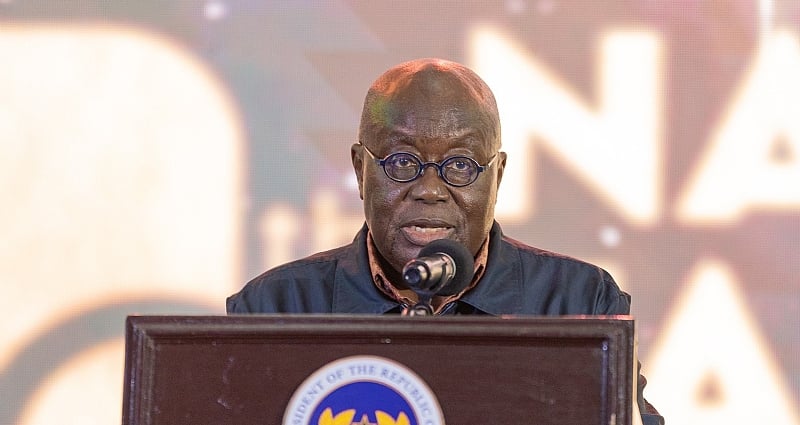
In a recent public address, President Addo Dankwa Akufo-Addo launched a vigorous critique against former President John Dramani Mahama, the National Democratic Congress (NDC) flagbearer, focusing particularly on Mahama’s proposed 24-hour economy policy. Just days before the crucial December 7 election, Akufo-Addo expressed skepticism over Mahama’s lack of a comprehensive roadmap for this policy, questioning its practicality and potential effects on Ghana’s economy. The President highlighted that the absence of a clear implementation strategy raises doubts about the viability of Mahama’s promises, suggesting that voters should be wary of what he deems as empty pledges lacking in substance and foresight.
President Akufo-Addo further seized the opportunity to draw contrasts between his administration and that of Mahama. He attributed the former President’s electoral loss in 2016 to his performance during his four years in office, which he claimed left many Ghanaians dissatisfied. By invoking historical electoral trends, Akufo-Addo asserted that all Presidents prior to Mahama were granted second terms, implying that Mahama’s failure to secure a second chance in the past was indicative of the public’s discontent with his governance. He contended that Mahama would inevitably face defeat again in the upcoming election in 2024, as the electorate would reject his candidacy based on his historical record.
In his remarks, the President also highlighted a specific issue that undermined Mahama’s credibility: the power crisis that plagued Ghana during Mahama’s presidency. He expressed doubts about Mahama’s capacity to implement a 24-hour economy effectively, given the substantial energy challenges demonstrably experienced while Mahama was in power. This criticism not only questioned Mahama’s proposed initiatives but also served to invoke memories of economic struggles the country faced during his previous tenure, furthering Akufo-Addo’s argument that reelecting Mahama would push the nation backward.
The President urged Ghanaians to reconsider their loyalty to Mahama, citing concerns over trustworthiness stemming from the former President’s record of governance, which included unfulfilled promises and perceived underperformance. Akufo-Addo specifically warned that a return to Mahama’s leadership could jeopardize significant policies enacted during his administration, highlighting the Free Senior High School (SHS) initiative as a crucial point of concern. He cautioned voters that a Mahama victory could threaten the educational advancements achieved under his administration, appealing directly to the electorate’s interest in sustaining progress in the education sector.
In a bid to rally support for the upcoming elections, President Akufo-Addo made a passionate appeal for Ghanaians to place their trust in the New Patriotic Party (NPP), urging them to vote for Dr. Mahamudu Bawumia, the party’s flagbearer. His message centered around the idea of continuity, growth, and a promise for a brighter future for Ghana. By endorsing Bawumia, the President framed the vote as a step toward ensuring stability and progress, contrasting NPP’s policies with what he characterized as Mahama’s questionable track record.
Ultimately, President Akufo-Addo’s remarks encapsulated a broader political narrative aimed at discrediting his predecessor while galvanizing support for his party in the lead-up to the December elections. By articulating concerns regarding Mahama’s strategies and governance history, the President sought to reinforce the notion that a vote for the NPP is synonymous with a commitment to forward-looking policies and sustained national development. His appeal to voters to embrace continuity under Bawumia emphasizes a desire to maintain the status quo of perceived progress made during his administration, positioning the NPP as the party of choice for those seeking to build on existing advancements in Ghana’s socio-economic landscape.








