





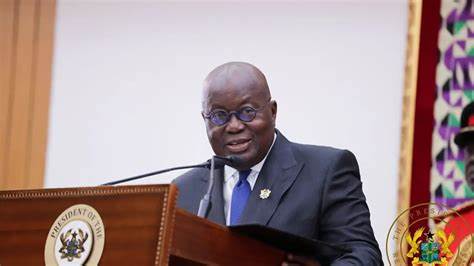
In a recent speech during the commissioning of the Sekyere Afram Plains District Hospital at Drobonso, President Nana Addo Dankwa Akufo-Addo harshly criticized former President John Dramani Mahama, labeling him a “failed president.” Akufo-Addo’s remarks highlighted what he viewed as Mahama’s inability to effectively govern, claiming that Mahama is uniquely recognized in Ghana as the only president who was not permitted to complete a full term due to poor performance. In stark contrast to the legacies of previous leaders, whom he acknowledged for their valuable contributions, Akufo-Addo focused on Mahama’s shortcomings, underscoring the widespread power outages his administration is associated with, commonly referred to as “Dumsor.” This environment has fostered skepticism among citizens regarding Mahama’s governance.
President Akufo-Addo also questioned the viability of Mahama’s proposed “24-hour economy,” suggesting that if Mahama failed to maintain consistent electricity supply during his presidency, it would be implausible for him to support a policy aimed at economic development that relies heavily on uninterrupted power. Dismissing the proposal as deceitful, Akufo-Addo urged the public to recognize the inconsistency in Mahama’s claims about economic administration. His remarks serve not only as a critique of Mahama’s past governance but also as a strategic attempt to undermine the credibility of the opposition party, the National Democratic Congress (NDC), ahead of the upcoming elections.
Additionally, President Akufo-Addo used the occasion to reinforce his administration’s achievements, primarily focusing on the Free Senior High School (Free SHS) policy, which he touted as a transformative initiative in education. He provided data showing a substantial increase in student enrollment from 800,000 to 1.6 million since the introduction of the policy, asserting that it has made significant strides in ensuring access to secondary education. Akufo-Addo’s emphasis on educational reform reflects his commitment to addressing educational disparities and expanding opportunities for Ghanaian youth, thereby framing his administration as responsive to the needs of its citizenry.
In his appeal to the electorate, he urged citizens to support Dr. Mahamudu Bawumia, the vice president, as the rightful successor to his initiatives and projects. He stressed that Bawumia would be tasked with following through on the programs introduced during his tenure, implying a continuation of his policies and progress. This strategic endorsement aims to solidify Bawumia’s position as more than just a political figurehead but as a capable leader who understands the vision laid out by the current administration.
Further, Akufo-Addo highlighted the historical context of education in Ghana, illustrating the challenges faced by over one million young Ghanaians who, due to financial constraints, were unable to access education over a decade. His administration’s decision to provide free schooling reflects a broader movement towards reducing educational barriers, he claimed. By drawing attention to the financial burdens previously faced by students and their families, Akufo-Addo aims to showcase the importance of the Free SHS policy as beneficial, not only to individuals but to the nation as a whole.
In conclusion, President Akufo-Addo’s sharp rebuke of Mahama’s legacy serves as a tactical maneuver in the political arena as Ghana approaches the upcoming elections. By contrasting his achievements—particularly in educational reforms—with what he presents as failures of the previous administration, Akufo-Addo seeks to secure his party’s continuity in governance through Bawumia. The framing of Mahama’s presidency as uniquely unsuccessful alongside a strong defense of current policies forms a powerful narrative intended to resonate with voters, emphasizing the necessity of prudent leadership and sustained development in Ghana’s political landscape.








