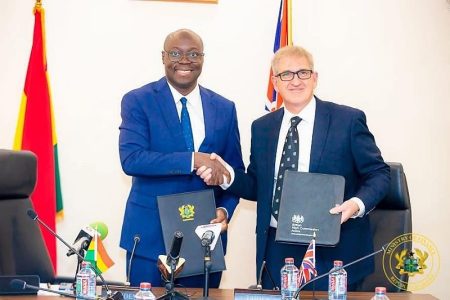
Dr. Mohamed Ibn Chambas, the African Union (AU) High Representative for Silencing the Guns, recently praised Vice President Dr. Mahamudu Bawumia and former President John Dramani Mahama during the signing of the Fourth Peace Pact in Accra. This Peace Pact aims to foster a peaceful electoral environment prior to the upcoming December 7 elections by encouraging political parties to commit to non-violence. In his keynote address, Dr. Chambas recognized the positive character and conduct of both candidates, representing the ruling New Patriotic Party (NPP) and the opposition National Democratic Congress (NDC), respectively. He expressed confidence that both leaders, known for their integrity and respect for human life, would lead their parties in a manner that avoids violence and bloodshed.
Dr. Chambas extended his gratitude to all candidates for their patience and their commitment to ensuring peaceful elections, emphasizing the need for a unified effort to promote non-violence and justice during the electoral process. He acknowledged the invaluable role of the National Peace Council and its leadership, along with the Institute of Democratic Governance (IDEG), for their relentless endeavors in facilitating dialogue among political stakeholders, civil society, and various international partners. This collective effort has solidified the importance of the Peace Pact as a cornerstone of Ghana’s electoral tradition, setting a precedent for the nation’s commitment to democratic processes.
The signing of the Peace Pact not only symbolizes the presidential candidates’ commitment to peaceful elections but also serves as a broader statement to the electorate and party supporters against violence. Dr. Chambas highlighted that their agreement stands as a pledge to uphold the rule of law and fair electoral practices, thus creating an atmosphere conducive to an uninterrupted electoral process. He reinforced the notion that there is no tolerance for violence within the framework of democratic elections, asserting that peaceful dialogue is the path to resolving any disputes that may arise.
In reference to a wider continental philosophy, Dr. Chambas reiterated the goals of the Silencing the Guns Initiative, which strives for a unified, peaceful Africa that can focus on developmental issues rather than conflict. He mentioned that poorly conducted elections have been a frequent trigger of conflict across the continent, and pointed out Ghana’s position as a paragon of successful election management. Many countries look to Ghana for best practices in electoral processes, underscoring its significant role as a model for maintaining peace and stability within West Africa.
Emphasizing collective responsibility, Dr. Chambas urged all stakeholders—including the Electoral Commission, Ghana Police Service, political activists, media representatives, and the judiciary—to work collaboratively toward ensuring credible, transparent, and inclusive elections. He noted that these entities hold critical responsibility in ensuring that the election results are accepted by all parties involved, thereby fostering trust in the democratic process. He cautioned against any form of complacency as elections drew near, highlighting that past achievements do not guarantee present or future success and reminding stakeholders that diligence is essential.
Finally, Dr. Chambas pointed out that with just days to the elections, the onus shifts to the institutions responsible for maintaining electoral integrity. He stressed the need for the Electoral Commission to operate with transparency and to address any concerns from critics to build public confidence. Additionally, he called for political leadership to refrain from hate speech and prevent incitement of violence from their supporters, reiterating that a successful electoral process hinges on cooperation, restraint, and commitment to the principles of peace. In conclusion, Dr. Chambas’s address serves as a compelling call to action for all involved in the electoral process, reinforcing a shared vision for a peaceful Ghana as it approaches its critical elections.