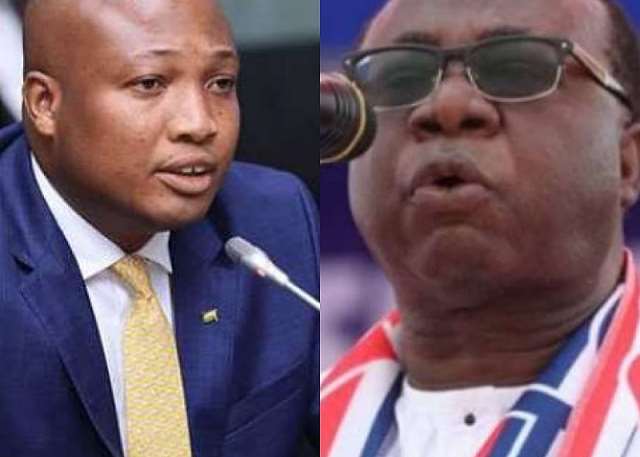
Freddie Blay, former National Chairman of the New Patriotic Party (NPP), has publicly questioned the financial standing of Samuel Okudzeto Ablakwa, Member of Parliament for North Tongu, sparking a debate about wealth accumulation, transparency, and political accusations. Blay’s central argument revolves around the perceived disparity between Ablakwa’s relatively short career in politics and his apparent ownership of substantial assets, including high-value properties. Blay, drawing on his own four-decade legal career and twelve-year tenure as a Member of Parliament, expressed incredulity at Ablakwa’s wealth, claiming he “has never worked in his life except being a minister and a Member of Parliament.” This comparison underscores Blay’s suspicion that Ablakwa’s financial success cannot solely be attributed to his political career.
Blay’s challenge to Ablakwa’s wealth is rooted in the broader context of public perception regarding the financial dealings of politicians. The question of how politicians amass their wealth is a recurring theme in public discourse, often fueled by suspicions of corruption and misuse of public funds. Blay’s remarks tap into this sentiment, suggesting that Ablakwa’s accumulated wealth is disproportionate to his known sources of income. This line of questioning is not uncommon in political spheres, where accusations of unexplained wealth often serve as a tool to discredit opponents and raise doubts about their integrity.
The dispute between Blay and Ablakwa is further complicated by allegations of “state capture” raised by Ablakwa against Blay’s son, Kwame Blay. Ablakwa accuses Kwame Blay of attempting to seize sections of the beachfront at Labadi Beach Hotel, a claim that Freddie Blay vehemently denies. Blay frames his son’s endeavors as legitimate business ventures, independent of government influence. He contrasts this with what he perceives as Ablakwa’s unfounded accusations, suggesting a double standard where Ablakwa questions the legitimacy of his son’s business dealings while seemingly enjoying unexplained wealth himself.
Blay’s public questioning of Ablakwa’s finances has brought the issue of transparency and accountability in Ghanaian politics to the forefront. While Blay’s assertions are yet to be substantiated with concrete evidence, they raise important questions about the need for greater transparency regarding the financial affairs of public officials. The public’s right to know how their elected representatives acquire their wealth is crucial for maintaining trust and ensuring accountability. Without clear mechanisms for demonstrating the legitimate acquisition of wealth, suspicions of corruption and illicit enrichment can easily fester, eroding public confidence in the political system.
The ongoing exchange between Blay and Ablakwa highlights the deep-seated tensions and mistrust that often characterize political rivalries. While Blay’s accusations against Ablakwa focus on financial matters, they are inextricably linked to the broader political landscape. Such accusations, whether substantiated or not, can have significant consequences for the reputations and careers of those involved. The public nature of these accusations adds another layer of complexity, as the court of public opinion often forms judgments before any formal investigations are conducted.
Ultimately, the Blay-Ablakwa dispute underscores the need for greater transparency and accountability within the Ghanaian political system. It highlights the importance of robust mechanisms for investigating allegations of corruption and unexplained wealth, as well as the need for clear guidelines regarding the financial disclosures of public officials. Addressing these issues is crucial not only for resolving individual disputes but also for strengthening public trust in the integrity of the political process. The ongoing debate serves as a reminder that public scrutiny of political figures’ financial dealings is a necessary component of a healthy democracy.