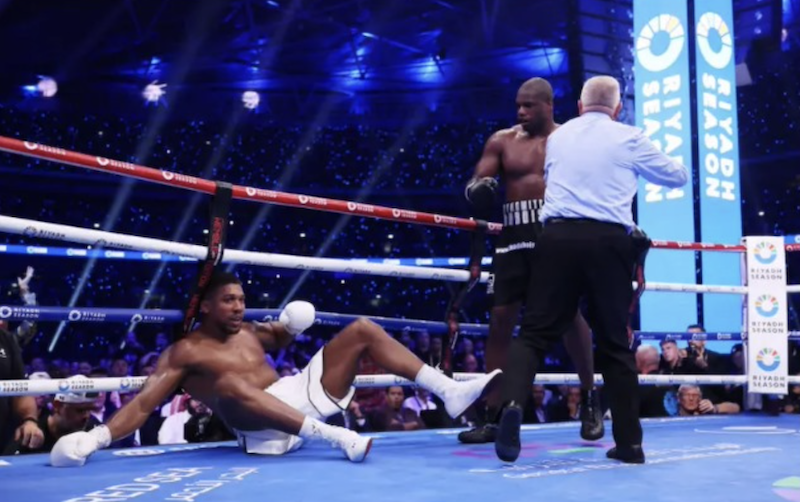
Anthony Joshua’s recent knockout defeat to Daniel Dubois at Wembley Stadium has undeniably left a significant mark on the British heavyweight boxer. The loss, his fourth in his professional career, was particularly brutal, with Joshua hitting the canvas four times before the referee finally called a halt to the contest in the fifth round. The sheer dominance displayed by Dubois, a younger and seemingly hungrier fighter, raised immediate questions about Joshua’s future in the sport, with many pundits and former boxers suggesting that retirement might be the wisest course of action.
Despite the calls for him to hang up his gloves and the undeniable sting of defeat, Joshua quickly made it clear that he had no intention of retiring. His promoter, Eddie Hearn, confirmed this sentiment, stating that retirement was never even a consideration for Joshua. According to Hearn, Joshua remains physically fit and motivated, and his focus has immediately shifted to how he can rebound from this setback and prove his doubters wrong. While acknowledging the emotional toll of the defeat, Hearn emphasized that Joshua’s immediate reaction was not one of despair but rather a determination to return to the ring stronger and more prepared.
The loss to Dubois was undoubtedly a humbling experience for Joshua. He endured a significant amount of punishment throughout the fight, and the repeated knockdowns were a stark reminder of his vulnerability in the ring. Hearn admitted that Joshua was "hurting" after the fight, both physically and emotionally. The experience of being repeatedly knocked down and ultimately stopped in front of a home crowd was likely humiliating for a fighter of Joshua’s stature. However, Hearn also highlighted Joshua’s resilience, pointing out that he never stopped trying to get back up, demonstrating a fighting spirit that suggests he is not yet ready to give up on his boxing career.
The key question facing Joshua now is not whether he will continue fighting, but how he will come back. The defeat to Dubois exposed certain weaknesses in his game, and it will be crucial for Joshua to address these issues if he hopes to regain his position as a top contender in the heavyweight division. He needs to analyze the fight, understand where he went wrong, and make the necessary adjustments in his training and tactics. This process will require honest self-reflection, expert guidance from his trainers, and a renewed dedication to improving his craft.
While Joshua’s physical condition remains good, the psychological impact of the loss cannot be underestimated. He needs to rebuild his confidence and overcome any lingering doubts that may have crept into his mind. This will likely involve a combination of physical training, sparring with high-quality opponents, and mental conditioning techniques to help him regain his focus and aggression. The road back to the top will be challenging, but if Joshua can successfully navigate these obstacles, he has the potential to rewrite the narrative of his career and prove his resilience in the face of adversity.
The coming months will be crucial for Joshua. He will need to carefully consider his next move, choosing his opponents wisely and focusing on rebuilding his reputation. He needs to prove to himself, and to the boxing world, that the loss to Dubois was not the end of his story but rather a catalyst for growth and improvement. The challenge ahead is significant, but Joshua’s history of overcoming adversity suggests that he has the potential to rise again and reclaim his place among boxing’s elite.