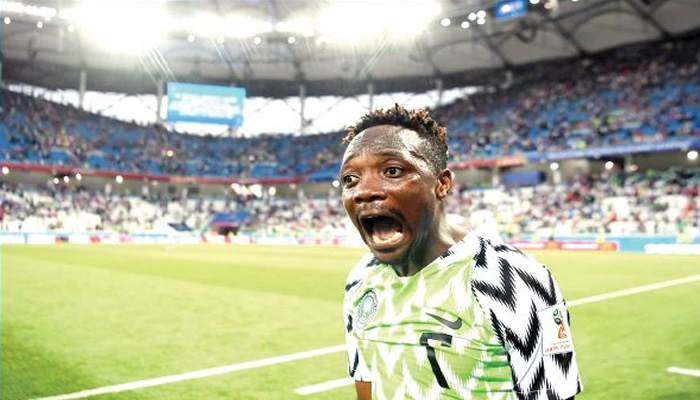
The Nigeria Super Eagles B team, preparing for the 2024 Championship of African Nations (CHAN) qualifiers against Ghana, faced an unexpected hurdle in their squad selection. Initially, the coaching staff, led by co-handler Fidelis Ilechukwu, had included Kano Pillars stars Ahmed Musa and Shehu Abdullahi in their provisional 30-man roster. Both players, having made high-profile returns to the Nigeria Premier Football League (NPFL), were expected to bolster the team’s chances. However, their inclusion was ultimately deemed ineligible due to the complexities of the Confederation of African Football (CAF) regulations governing player participation in the CHAN tournament.
The news of Musa and Shehu’s omission surprised many, considering their prominent status within the NPFL. Ilechukwu confirmed that both players were indeed on the initial list, highlighting Musa’s strong league performances as a key reason for his selection. However, the coaching staff was subsequently instructed to remove them due to eligibility concerns. This decision stemmed from specific clauses within the CAF regulations, particularly those concerning player contracts and registration within their respective domestic leagues.
The primary CAF regulation stipulating player eligibility for CHAN mandates that players must be active in their country of birth’s domestic league. This condition was met by both Musa and Shehu, as they were playing for Kano Pillars in the NPFL. However, a further stipulation concerning the nature of their contracts posed a significant obstacle. CAF regulations require players to possess “permanent contracts” registered with a local club affiliated with their national association. The ambiguity arose from Musa and Shehu’s participation in the NPFL under the “Elite Player Scheme.” This scheme allows NPFL clubs to register a maximum of two players who are deemed to “add value” to the league, often involving unique contractual arrangements.
The Elite Player Scheme, while designed to enhance the quality of the NPFL, seemingly created a grey area regarding player eligibility for CHAN. The scheme’s framework, outlined in section 9.91 of the NPFL Framework and Rules, doesn’t explicitly address the compatibility of these special contracts with CAF’s requirements for permanent registration. This ambiguity ultimately led to the exclusion of Musa and Shehu, as their participation under the Elite Player Scheme raised doubts about their fulfillment of the “permanent contract” stipulation. The NPFL itself couldn’t definitively clarify the players’ eligibility, deferring the matter to the Nigeria Football Federation (NFF).
Attempts to obtain clarification from the NFF, however, proved unsuccessful. The NFF General Secretary, Mohammed Sanusi, who had recently received a three-year tenure extension, remained unreachable for comment. This lack of communication further complicated the situation and left the coaching staff with no option but to exclude Musa and Shehu from the final 30-man squad. The incident highlights the intricacies of player eligibility rules within African football and the challenges they can pose for national team selections. The absence of two experienced and talented players like Musa and Shehu undoubtedly impacts the Super Eagles B’s preparations for the crucial CHAN qualifiers against Ghana.
The CHAN tournament, now in its eighth edition, is a unique competition exclusively for players competing in their respective domestic leagues. The 2025 edition is scheduled to be co-hosted by Kenya, Uganda, and Tanzania in February. Nigeria, despite being a footballing powerhouse on the continent, has yet to win the CHAN title. Their best performances came in 2014, where they finished third in South Africa, and in 2018, where they reached the final but lost to hosts Morocco. The exclusion of Musa and Shehu underscores the challenges the Super Eagles B face in their quest to finally claim the CHAN trophy. The team will now have to rely on the remaining players in their squad to navigate the qualifiers against Ghana and hopefully secure a place in the 2025 tournament. Their success will depend on their ability to overcome the absence of key players and build a cohesive and competitive unit for the challenging matches ahead.