









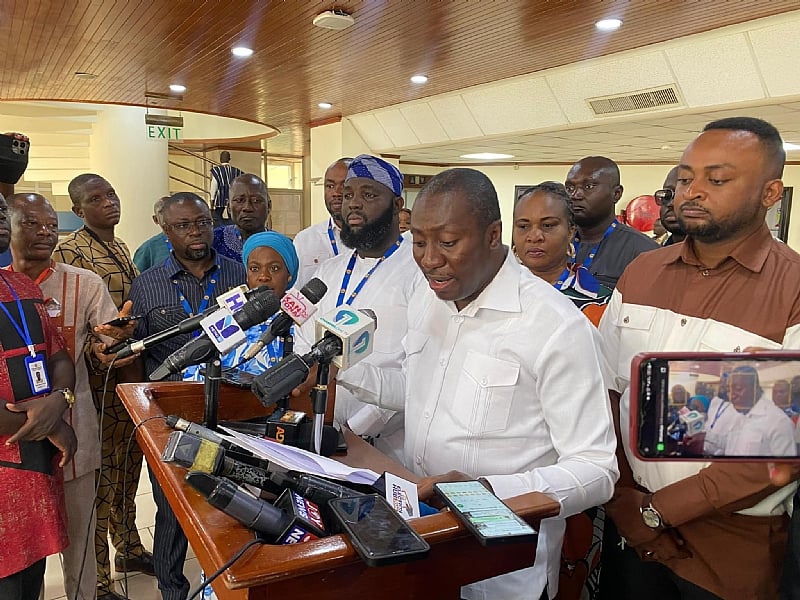
The political landscape in Ghana witnessed a significant development with the Minority in Parliament pledging their full cooperation and support to President John Dramani Mahama. This commitment signifies a potential shift towards a more collaborative approach to governance, emphasizing mutual respect and adherence to established protocols. The Minority’s assurance follows a recent incident involving a controversial raid on the residence of former Finance Minister Ken Ofori-Atta, an event that prompted an apology from Majority Leader Mahama Ayariga. This gesture of reconciliation seems to have paved the way for a more constructive relationship between the opposing sides in Parliament, fostering an environment conducive to effective governance.
The raid on Ofori-Atta’s residence, conducted by National Security operative Richard Jakpa accompanied by individuals in police and military uniforms, sparked considerable controversy. The circumstances surrounding the operation, including the justification for its execution and the involvement of individuals seemingly impersonating law enforcement officials, raised concerns about the adherence to due process and the potential abuse of power. Majority Leader Ayariga’s subsequent apology to the former Finance Minister can be interpreted as an acknowledgement of the impropriety of the raid and a gesture aimed at de-escalating the tension arising from the incident. This apology appears to have played a crucial role in facilitating the Minority’s conciliatory response and their pledge of cooperation with the President.
Minority Leader Alexander Afenyo-Markin’s response to the apology was particularly noteworthy. He welcomed the government’s move, emphasizing its significance in upholding civility and accountability in national affairs. His statement reflects a recognition of the importance of maintaining decorum and respecting established procedures, even in the face of political disagreements. By acknowledging the government’s apology and reciprocating with a pledge of cooperation, Afenyo-Markin signaled a willingness to move beyond the contentious incident and engage in a more constructive dialogue with the ruling party. This sets a positive precedent for future interactions and suggests a potential for greater collaboration on matters of national importance.
Afenyo-Markin’s assurance of cooperation extended beyond mere procedural matters. He explicitly conveyed to President Mahama the Minority’s commitment to accord him the respect and courtesy due to his office. This indicates a deeper understanding of the importance of respecting the institution of the presidency, regardless of political affiliations. By separating political opposition from the respect owed to the head of state, the Minority demonstrates a mature and principled approach to governance. This distinction is crucial for maintaining the stability and integrity of democratic institutions.
Furthermore, Afenyo-Markin’s statement highlighted the dual role of the Minority in Parliament: to cooperate with the government when necessary and to oppose when deemed appropriate. This balanced approach acknowledges the responsibility of the opposition to both contribute to the legislative process and hold the government accountable. By emphasizing this dual role, the Minority underscores their commitment to fulfilling their constitutional mandate and serving the interests of the people they represent. This balanced approach to opposition politics contributes to a more robust and effective democratic system.
In essence, the Minority’s pledge of cooperation signifies a potential turning point in the political landscape of Ghana. By prioritizing respectful dialogue, adhering to established protocols, and recognizing the importance of both cooperation and opposition, they have laid the groundwork for a more productive and collaborative relationship with the government. This development holds promise for more effective governance and a greater focus on addressing the challenges facing the nation. The commitment to respectful engagement and constructive dialogue sets a positive example for political discourse and reinforces the principles of democratic governance. This collaborative approach, while maintaining the necessary checks and balances, has the potential to foster a more stable and prosperous future for Ghana.









