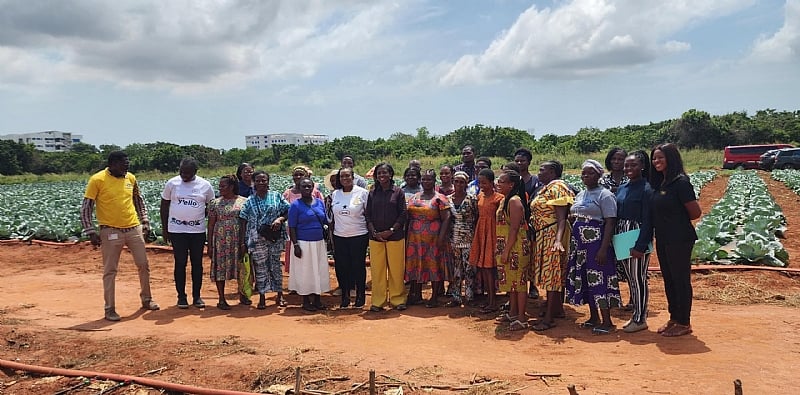
The MTN Ghana Foundation recently celebrated the International Day of Rural Women by focusing on empowering female farmers in the La Nkwantanang District with vital digital farming skills. The event, hosted at Umoja Farms within the grounds of the Legon Presbyterian Secondary School in Accra, was dedicated to showcasing smart farming techniques aimed at improving agricultural productivity among rural women. Adwoa Afriyie Wiafe, the Chief Corporate Services and Sustainability Officer for MTN Ghana, emphasized the foundation’s commitment to advancing the adoption of modern farming methods among rural women to help enhance their agricultural yields. In collaboration with the La Nkwantanang District Agricultural Office, the foundation aims to assist 160 women farmers, initiating the project with a pilot group of 40 to 50 participants who will be provided with training and necessary resources to implement these innovative farming approaches.
Wiafe highlighted the increasing scarcity of farmland as a significant challenge, underscoring the necessity to optimize the limited land available through smart farming practices utilizing technological advancements. She noted that digital methods in agriculture hold the potential to significantly boost yields and augment productivity, especially in the current climate of resource constraints. Furthermore, she encouraged the younger generation, particularly women, to explore agricultural opportunities, stressing that modern farming is integral to income generation and community development, and that it now heavily incorporates technology rather than outdated methods.
Beneficiaries of the program, like Ami Christelle Gle, shared their success stories, illustrating the positive impact of the training provided by the MTN Foundation in partnership with Holland Green Tech. Gle spoke of her transformation through the adoption of techniques such as drip irrigation and precise fertilizer application, which have allowed her to harvest crops like Mawenzili pepper and habanero successfully. Despite grappling with market pricing issues, she expressed gratitude for the program and urged other women engaged in agriculture to adopt digital farming methodologies, highlighting how these techniques can lead to tangible improvements in productivity.
Adding to the discourse on innovative farming practices was Charles Kwesi Agyemang, co-founder and general manager of Farmers Group Limited. He showcased advanced irrigation technology designed to enhance crop productivity while minimizing labor-intensive farming activities. Agyemang elaborated that the system enables farmers to effectively mix fertilizer with water, thereby delivering essential nutrients throughout the crop lifecycle. This technology not only boosts farm productivity but also attracts younger individuals to agriculture by alleviating the physically demanding aspects of traditional farming techniques, ultimately making it a more appealing field for future generations.
Additionally, young farmer Jame Asinyor echoed the benefits of adopting smart farming practices, stating that they provide more value than conventional methods. He implored fellow youth to actively participate in agriculture and seize opportunities offered by modern techniques to secure improved livelihoods. The overall message emanating from the event underscored the notion that the future of farming lies in embracing change and innovation, particularly through the application of technology, which can significantly enhance productivity and economic sustainability among rural populations.
The initiative rolled out by the MTN Ghana Foundation and its collaborators is expected to foster considerable improvements in agricultural productivity, alongside promoting economic empowerment among rural women farmers across Ghana. By facilitating the introduction and adoption of contemporary farming techniques, the program aims not only to uplift the women involved but also to set a precedent for the next generation, motivating them to engage with agriculture from a modern, technology-driven perspective. This approach is anticipated to serve as a catalyst for change, encouraging more women to engage in farming as a viable and profitable endeavor, which in turn could lead to broader socioeconomic benefits for their communities.