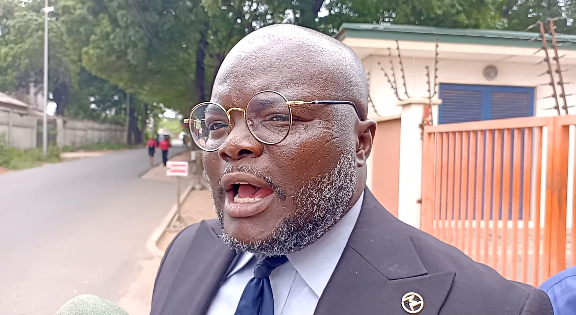
Kwame Owusu Danso, the running mate of Alan Kwadwo Kyerematen, has articulated the belief that Kyerematen’s departure from the New Patriotic Party (NPP) is ultimately in the best interest of Ghana. Danso’s assertion comes in the context of significant consequences for the country’s economic development initiatives, particularly with respect to Kyerematen’s signature program, One District, One Factory (1D1F). His comments shed light on a growing dissatisfaction with the current government’s approach to developmental projects, raising doubts about its genuine commitment to enhancing the nation’s economic landscape. Danso emphasizes that Kyerematen’s original vision for 1D1F was to address the severe unemployment issues facing Ghanaians but has faced political sidelining due to internal party rivalries.
During a recent interview on Kingdom FM with Fiifi Praat, Danso remarked that the 1D1F initiative, which seeks to establish at least one factory in each district, was a fundamental strategy developed by Kyerematen to foster employment and economic development throughout Ghana. He pointed out that the initiative was not merely a political promise but a well-conceived plan aimed at transforming the economic fabric of the nation. Danso expressed his frustration, indicating that Kyerematen’s ideas were marginalized because of his ambition to contest for the NPP’s presidential candidacy. Such political competition, according to Danso, has adversely affected the prioritization and implementation of critical development agendas.
Shifting the focus to funding disparities between Kyerematen’s 1D1F initiative and the National Builders Corps (NABCO), Danso revealed that Kyerematen was allocated a mere GHC 400 million for his ambitious plan, a figure he considers dreadfully insufficient for the initiative’s success. He starkly contrasts this with the staggering GHC 4 billion allocated to the NABCO program. Initially conceived as a measure to engage the youth in productive employment and skill acquisition, NABCO has been criticized by Danso as a failure. He described it as a “sham,” asserting that despite the substantial funding, the program has delivered minimal impact and resulted in negligible benefits for young Ghanaians.
The disparity in funding priorities raises significant questions about the government’s commitment to sustainable economic development as opposed to short-term employment solutions. Danso’s critique of NABCO suggests a broader concern regarding the effectiveness and transparency of government projects intended to uplift young people. He highlighted that while the funds for NABCO were available, the promised outcomes fell short, indicating a misalignment between government priorities and the genuine needs of the youth. Danso’s comments suggest a call for a reevaluation of how development programs are funded and executed, stressing the need for a strategic focus on sustainable job creation over temporary employment measures.
Danso’s remarks also serve as a critique of the existing political dynamics within the NPP and how they impact developmental initiatives. He indicated that the internal politics and rivalries have not only hindered Kyerematen’s vision but have ultimately stalled progress on critical projects that could lead to meaningful economic advancement for the country. This raises concerns about whether political maneuvering within parties hinders the broader developmental goals that affect the entire nation. The implication is that if political leaders are more focused on party power struggles than on serving the public good, the consequences may be detrimental to economic and social progress.
In conclusion, Mr. Kwame Owusu Danso’s statements emphasize the importance of prioritizing genuine developmental initiatives over politically motivated decisions. His advocacy for Kyerematen’s 1D1F initiative highlights a broader narrative regarding the need for sustainable economic strategies that address the root causes of unemployment and economic stagnation in Ghana. The criticism of the NABCO program serves as a reminder of how misallocation of resources can undermine potential avenues for real economic development, urging a recalibration of priorities in the face of internal political challenges. The dialogue initiated by Danso calls for a concerted effort from political leaders to rise above party politics and focus on the pressing economic issues facing the nation, ensuring that the interests of the Ghanaian populace are placed at the forefront of governance.