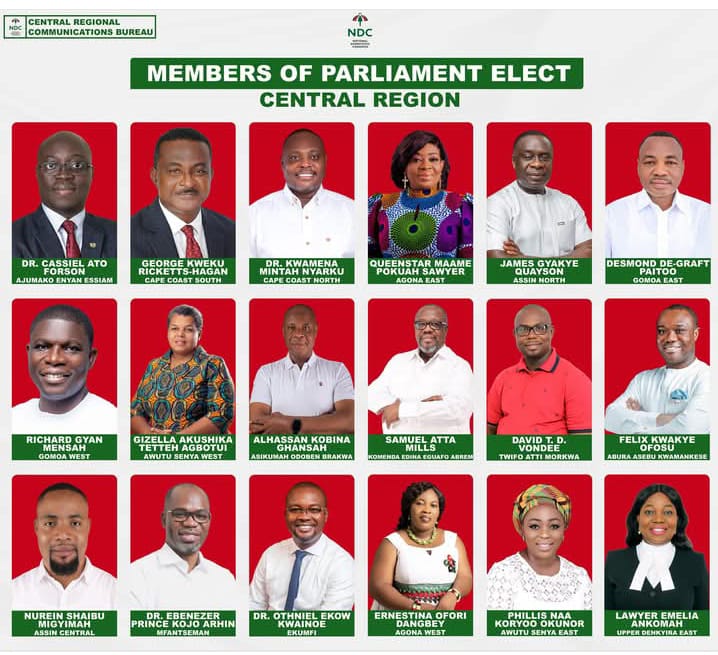
The 2024 general elections in Ghana’s Central Region delivered a resounding defeat for the incumbent New Patriotic Party (NPP), with the opposition National Democratic Congress (NDC) securing a landslide victory. The NDC captured 18 out of the 23 parliamentary seats, a dramatic increase from their previous 13 seats in 2020, leaving the NPP with a meager four seats and an independent candidate claiming the remaining one. This outcome represents a significant shift in the political landscape of the region, traditionally considered a swing region, and underscores a profound change in voter sentiment. The NDC’s success also reflects a broader national trend of dissatisfaction with the NPP government’s performance, particularly regarding the economy.
The NDC’s triumph in the Central Region was not merely a numerical victory but a symbolic conquest of key NPP strongholds. The Awutu-Senya-East constituency, held by the NPP since 2012, flipped to the NDC with Phyllis Naa Koryoo Okunor defeating the incumbent Minister of Fisheries and Aquaculture Development, Mavis Hawa Koomson. Similarly, Awutu-Senya-West saw Gizella Tetteh Agbotui secure a second term, overcoming Eugene Arhin, the Director of Communications for President Akufo-Addo. These victories, coupled with wins in Gomoa West and Gomoa East, demonstrate the NDC’s effective campaign strategy and the depth of voter disillusionment with the NPP.
Adding to the NPP’s woes, the Gomoa Central constituency, a traditional NPP stronghold, was won by independent candidate Kwame Asare Obeng, popularly known as ‘A Plus’. This unprecedented victory for an independent candidate in this constituency further underscores the fragmentation of the NPP’s support base and the growing appeal of alternative political voices. The NDC’s wins also extended to Ekumfi, Mfantseman, and Cape Coast North, where incumbent NDC MP Kwamina Minta Nyarku secured a second term. The results clearly indicated a widespread rejection of the NPP across the region.
The few victories secured by the NPP offered little solace in the face of such a comprehensive defeat. Alexander Afenyo-Markin retained his seat in Effutu, while Rev. John Ntim Fordjour narrowly secured a third term in Assin South. Lawrence Agyinsam won the Hemang-Lower-Denkyira seat and Rudolf Amoako Gyampah held onto Upper Denkyira West for the NPP. These isolated wins, however, were overshadowed by the NDC’s dominance, and highlighted the NPP’s struggle to connect with voters in the region.
Beyond the individual constituency battles, the overall vote count in the presidential race further emphasized the NDC’s ascendancy and the NPP’s decline. The NDC garnered a significant lead with 562,620 votes, while the NPP trailed behind with 382,749. This margin reflects a growing preference for the NDC at the presidential level, further solidifying their dominance in the region. Even in constituencies where the NPP managed to retain parliamentary seats, the presidential vote often favored the NDC, suggesting a split-ticket voting trend – voters choosing NDC for president while opting for local NPP representation.
Post-election analysis and voter feedback revealed several contributing factors to the NPP’s significant losses. Accusations of arrogance, disrespect, and a lack of empathy from NPP MPs resonated among voters. The government’s perceived insensitivity to the economic hardships faced by the populace further fueled dissatisfaction. Conversely, the NDC’s strategic focus on grassroots mobilization, house-to-house campaigns, and engagement with local leaders proved highly effective. By tapping into the prevailing economic anxieties and positioning themselves as the party best suited to address these concerns, the NDC successfully resonated with voters seeking change and a more responsive government. Their campaign messaging focused on alleviating hardship and “resetting” Ghana for a brighter future, a message that clearly resonated with a populace grappling with economic challenges. The NDC also capitalized on its traditional strongholds, maximizing voter turnout through targeted engagement.