









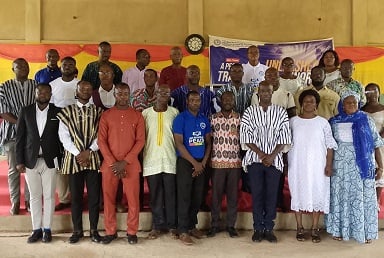
The National Commission for Civic Education (NCCE) has initiated a nationwide campaign titled “Together, We Can Build Ghana: So, Get Involved,” aimed at promoting peaceful coexistence and fostering national cohesion to enhance the country’s democratic processes. This initiative highlights the importance of unity among citizens, transcending political, religious, tribal, and social divides, especially as Ghana approaches the crucial 2024 Presidential and Parliamentary Elections. The campaign not only seeks to mobilize citizens towards a common good but also emphasizes the shared identity of Ghanaians. In this context, outreach sessions have been organized in the Upper Manya Krobo District, specifically in Asesewa, in collaboration with the Inter-Party Dialogue Committee (IPDC) to engage faith-based organizations in dialogue aimed at enhancing peace and unity.
Central to the outreach sessions was the message of unity conveyed by Mr. Eric K. Yanney, the NCCE District Director. He firmly stated that despite the political climate, Ghanaians should remain united post-elections. His call for cohesiveness highlighted that discord among citizens could stall the nation’s progress. Yanney’s remarks emphasize a collective responsibility to reject violence and aspire for peace. This theme was echoed by the District Police Commander, Superintendent Francis Mensah, who cautioned against any form of violence, reminding voters that such actions are punishable under the Vigilantism and Related Offences Bill of 2019. His reassurance of police readiness to maintain safety during the electoral period underscores the commitment to uphold law and order.
Addressing the role of religious institutions, IPDC Chairman Mr. Isaac Ofei Baah praised local churches for their engagement in promoting political awareness and peaceful cohabitation. Echoing the Constitutional mandate under Article 41(a) of Ghana’s 1992 Constitution, Baah called for respect across political, ethnic, and religious lines, essential for nurturing peace within the community. Notably, he drew attention to the threat posed by misinformation, stating that the proliferation of false news could undermine trust in democratic institutions and lead to instability. This observation highlights the intricate relationship between informed citizenship and national security, emphasizing that peace initiatives must also tackle the challenge of misinformation.
Mr. Haludu Mohamed from the National Intelligence Bureau (NIB) focused on the youth’s crucial role in maintaining peace as they directly influence societal dynamics, urging them to opt for dialogue over violence in conflict resolution. His clarification that the freedom of speech does not encompass the dissemination of misinformation further underscores that certain liberties come with responsibilities, particularly when public safety is at stake. In this spectrum, the campaign’s emphasis on dialogue becomes a foundational principle aimed at cultivating respect and understanding within the community.
Traditional and religious leaders also played a pivotal role in encouraging tolerance among citizens. Nene Olesu Tetteh, Asesewa’s Sipim, encouraged religious organizations to be front-runners in promoting peaceful coexistence by validating electoral integrity and moral values through religious teachings. By intertwining faith with civic responsibilities, he advocates for a community where mutual respect prevails, especially during politically charged times. This approach of using faith-based initiatives to foster peace speaks to a broader understanding of how various societal institutions can work together for the greater good.
Thus far, the collaborative efforts between the IPDC and NCCE have successfully engaged 13 faith-based organizations in the Upper Manya Krobo District, including significant institutions like the Nazareth Presbyterian Church, St. Augustine Catholic Church, and Asesewa Central Mosque. These engagements have facilitated discussions on key issues, such as political tolerance, the impact of misinformation, and the role of financial influence in politics. By creating a platform where these critical topics are openly discussed, the campaign aims to lay a robust foundation for unity and peace as the nation approaches the elections, forming a collective commitment to uphold democratic values while fostering a sense of belonging among all Ghanaians.









