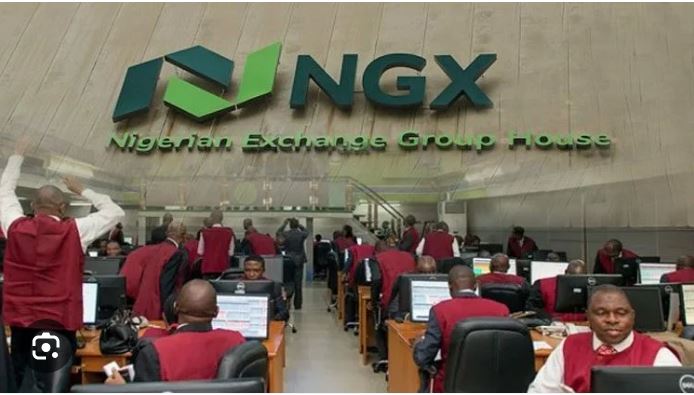
The Nigerian Exchange (NGX) concluded the week on a somber note, as the equities market experienced a downturn, shedding N48 billion in market capitalization. This decline underscores the persistent negative sentiment prevailing among investors, casting a shadow over the market’s performance. The closing figures painted a picture of contraction, with the market capitalization settling at N70.5 trillion, down from N70.548 trillion the previous day. The All-Share Index, a key indicator of overall market health, also mirrored this downward trend, depreciating by 76.07 points, or 0.07 percent, to close at 111,742.01 points. This dip suggests a broad-based decline across the listed equities.
Despite the prevailing negative sentiment reflected in the declining indices, trading activity on the NGX witnessed a significant surge. A staggering 1.9 billion shares, valued at N64.15 billion, exchanged hands in 18,653 deals. This represents a remarkable 242 percent increase in volume and an even more impressive 274 percent surge in turnover compared to the preceding trading session. This surge in activity suggests that despite the overall market downturn, certain pockets of opportunity attracted significant investor interest, leading to heightened trading volumes. The increased activity could be attributed to bargain hunting by investors seeking undervalued stocks amidst the market decline, or speculative trading driven by short-term market fluctuations.
Market breadth, a measure of the overall direction of the market, closed negative, indicating a preponderance of losing stocks over gainers. Out of the 128 listed equities that participated in the trading session, 27 advanced while 37 declined. This negative breadth further reinforces the prevailing bearish sentiment in the market, suggesting that the selling pressure outweighed buying interest across a majority of listed companies. The negative market breadth, coupled with the decline in major indices, paints a picture of a market grappling with widespread investor concerns, potentially stemming from macroeconomic factors, industry-specific challenges, or broader global market trends.
Among the gainers, Omatek Ventures Plc led the pack with a 9.86 percent surge, closing at N0.78 per share. Red Star Express followed closely with a 9.62 percent gain, while Deap Capital and Sovereign Trust Insurance also registered substantial increases of 9.38 percent and 9.09 percent, respectively. Other notable gainers included May & Baker, which appreciated by 8.26 percent, and Cutix Plc, which climbed 6.88 percent. These gains, although encouraging, represent a relatively small segment of the market, as evidenced by the negative market breadth.
Conversely, the losers’ chart was dominated by Beta Glass Plc and NCR Nigeria, both plummeting by 10 percent to close at N232.65 and N6.57, respectively. Conoil Plc trailed closely with a 9.99 percent decline, ending the session at N298.10, while Legend Internet shed 9.94 percent to settle at N6.16. These significant declines among prominent companies contributed heavily to the overall negative market performance, highlighting the widespread impact of the prevailing bearish sentiment. The specific reasons for these declines would require further analysis, potentially focusing on company-specific news, industry trends, or broader economic factors.
In terms of trading volume, United Bank for Africa (UBA) emerged as the most actively traded stock, with over 1.41 billion shares changing hands. This high volume suggests significant investor interest in UBA, possibly driven by recent news, earnings reports, or strategic announcements. Following UBA, United Capital saw 66.8 million shares traded, while Access Holdings and Fidelity Bank recorded 54 million and 31.4 million shares, respectively. These high trading volumes indicate a dynamic market with active participation from investors, even amidst the overall bearish sentiment.
Analyzing sector performance provides further insights into the market dynamics. The Banking Index, a key indicator of the financial sector’s health, registered a 0.36 percent decline, reflecting the challenges faced by the banking industry. The Industrial Index also mirrored this downward trend, falling by 0.16 percent. The Main Board Index, representing the overall performance of established companies, experienced a 0.33 percent drop. However, amidst this widespread decline, the Premium Index displayed resilience, gaining 0.47 percent. This suggests a relative strength among premium stocks, potentially driven by investor preference for established and stable companies during periods of market uncertainty.
Despite the week’s negative closing, the market’s longer-term performance paints a slightly more optimistic picture. Over a one-week period, the market recorded a gain of 2.49 percent, while a four-week perspective reveals a more substantial 5.37 percent increase. Furthermore, the year-to-date return stands at 8.56 percent, indicating that despite short-term fluctuations and the prevailing bearish sentiment, the market has demonstrated positive growth over a longer horizon. This suggests that while short-term market volatility can influence investor behavior, the underlying fundamentals of the Nigerian economy and its listed companies might still hold potential for long-term growth. This longer-term perspective provides a more nuanced understanding of the market’s performance, highlighting the importance of considering different timeframes when assessing investment returns and market trends.