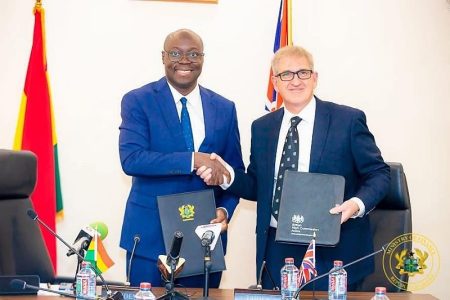
The declaration of former Finance Minister Ken Ofori-Atta as a wanted fugitive of justice by Special Prosecutor Kissi Agyebeng has ignited controversy and sparked sharp criticism, particularly from Dr. Palgrave Boakye-Danquah, former government spokesperson on Governance and Security. Dr. Boakye-Danquah contends that the Special Prosecutor’s characterization of Mr. Ofori-Atta as a fugitive is fundamentally flawed and demonstrates a lack of understanding of legal principles. He argues that a fugitive is an individual who has evaded imprisonment after being convicted of a crime, not someone merely accused of wrongdoing. This, he asserts, is a critical distinction that the Special Prosecutor appears to have overlooked.
Dr. Boakye-Danquah points to Sedina Tamakloe, the former CEO of the Microfinance and Small Loans Centre (MASLOC), as a more fitting example of a fugitive. Ms. Tamakloe was sentenced in absentia to a ten-year jail term for misappropriation of state funds and is currently residing in the United States, evading her sentence. He argues that the Special Prosecutor’s pursuit of Mr. Ofori-Atta while neglecting to pursue Ms. Tamakloe, a convicted criminal actively evading justice, exposes a lack of prioritization and a misunderstanding of the legal definition of a fugitive. This, he claims, undermines the credibility of the Special Prosecutor’s office and casts doubt on his legal competence.
Dr. Boakye-Danquah’s critique extends beyond the legal definition of a fugitive. He accuses the Special Prosecutor of creating a national embarrassment and turning Ghana into a laughingstock on the international stage. He questions the diplomatic handling of the situation, suggesting that the Special Prosecutor’s actions have tarnished Ghana’s image abroad. He paints a picture of a country whose reputation is being defined by this incident, overshadowing its positive attributes such as its gold, cocoa, oil, and the national football team, the Black Stars. He laments that the narrative surrounding Ghana is shifting from one of national pride to one of scandal and governmental impropriety.
Furthermore, Dr. Boakye-Danquah raises concerns about the potential damage to Ghana’s international standing. He suggests that the Special Prosecutor’s actions have created an environment where the country is perceived as a haven for corruption and impunity. This, he argues, could have detrimental effects on foreign investment, international cooperation, and Ghana’s overall reputation in the global community. He emphasizes the importance of upholding the rule of law and pursuing justice in a manner that respects due process and avoids undermining the country’s image.
Dr. Boakye-Danquah’s criticisms highlight a broader debate about the role and responsibilities of the Special Prosecutor. He questions whether the office is being used effectively to combat corruption or whether it is becoming a tool for political maneuvering and grandstanding. He implicitly raises concerns about the independence and impartiality of the Special Prosecutor, suggesting that the pursuit of Mr. Ofori-Atta might be motivated by factors other than a genuine commitment to justice.
In essence, Dr. Boakye-Danquah’s critique of the Special Prosecutor’s actions boils down to three central points: a misapplication of the legal definition of a fugitive, a damaging impact on Ghana’s international reputation, and a questioning of the Special Prosecutor’s motivations and competence. He calls for a more judicious and measured approach to pursuing corruption cases, one that prioritizes actual fugitives from justice and upholds the principles of due process and diplomatic conduct. He argues that this is essential not only for maintaining the integrity of the legal system but also for preserving Ghana’s standing on the global stage.