





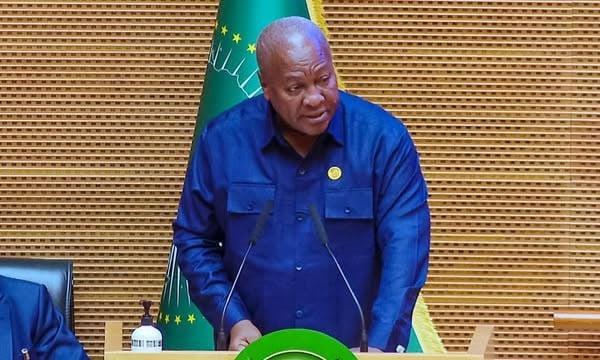
John Dramani Mahama, former President of Ghana, has strongly endorsed the African Union’s (AU) call for Reparatory Justice for Africans and people of African descent. He emphasized the AU’s commitment to rectifying historical injustices and their enduring impact across generations. Speaking at the 38th Ordinary Session of the AU Assembly of Heads of State and Government in Addis Ababa, Ethiopia, Mahama highlighted the significance of the session’s theme, “Justice for Africans and People of African Descent through Reparations,” as a critical step towards achieving justice, equity, and acknowledging the pervasive consequences of historical wrongs. He positioned this as a crucial moment in the pursuit of equity and recognition of the historical injustices that continue to shape the lived experiences of Africans and their descendants globally.
Mahama recalled the AU’s landmark decision at its 37th Ordinary Session to dedicate 2025 to the cause of Reparatory Justice, aligning it with the broader objectives of liberation, unity, and socio-economic empowerment outlined in Agenda 2063, the AU’s vision for an integrated, prosperous, and peaceful Africa. He condemned the transatlantic slave trade as one of history’s gravest crimes against humanity, a 400-year period that forcibly displaced over 12.5 million Africans, with an estimated two million perishing during the Middle Passage alone. He further connected the lingering effects of slavery with the legacies of colonialism, apartheid, genocide, and neo-colonial exploitation, arguing that these historical traumas have inflicted deep and lasting wounds upon African societies. The descendants of enslaved Africans, he noted, still grapple with economic disparities, social inequality, systemic discrimination, and racial prejudice.
Addressing these challenges, Mahama asserted, requires more than mere acknowledgment; it demands concrete action. He detailed the profound economic impact of colonialism on Africa, citing estimates suggesting trillions of dollars lost in human and material resources due to colonial exploitation. The forced extraction of wealth, encompassing minerals, cash crops, and labor, deprived African nations of the capital and infrastructure crucial for sustainable development. Colonial policies, he argued, intentionally stifled industrial growth, creating a dependence on foreign economies that persists to this day. He linked the systemic plundering of Africa’s resources and the disruption of traditional governance structures to enduring poverty, underdevelopment, and inequality across the continent.
Mahama highlighted Ghana’s hosting of the Accra Reparations Conference in November 2023, a pivotal event that brought together African heads of state, scholars, and diaspora representatives to bolster the reparations movement. The conference, he noted, reinforced the urgent need for comprehensive reparatory justice and laid the groundwork for more robust advocacy and policy frameworks. Thus, the AU’s 2025 theme serves as a call to action, urging intensified efforts towards reparatory justice and ensuring the full restoration of the dignity, rights, and well-being of Africans and their descendants.
The concept of reparations, as defined by Mahama, transcends mere financial compensation. It encompasses restitution, rehabilitation, and guarantees of non-repetition of the abuses inflicted upon fellow human beings. Crucially, it involves truth-telling, historical accountability, and the restoration of agency to those marginalized for centuries. The call for reparations extends beyond monetary redress, aiming to address structural inequalities, ensure educational and economic opportunities, reclaim cultural heritage, and amplify the voice of Africa and its diaspora communities on the global stage. Mahama’s address underscores the multifaceted nature of reparations and its potential to contribute to healing, reconciliation, and a more just future for Africans and people of African descent.
In essence, Mahama’s speech powerfully advocates for a comprehensive approach to reparatory justice, emphasizing its significance in addressing the lingering effects of historical injustices. He framed the pursuit of reparations as a vital component of achieving the AU’s vision for a united, prosperous, and self-determined Africa, highlighting the need for concrete actions that go beyond mere acknowledgment of past wrongs. His emphasis on truth-telling, historical accountability, and the restoration of agency underscores the transformative potential of reparatory justice to heal historical wounds and create a more equitable future for all. The dedication of 2025 to this cause by the AU, as championed by Mahama, represents a significant step towards achieving this goal.








