





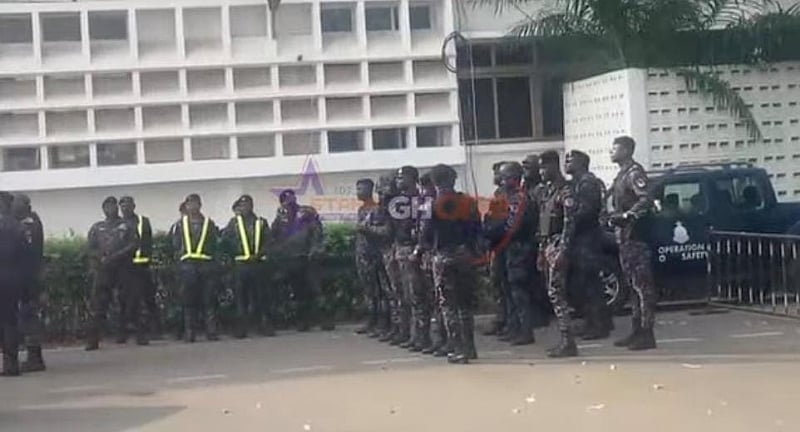
The Supreme Court of Ghana is poised to adjudicate a critical election dispute case that has generated significant political tension and raised concerns about the integrity of the electoral process. The case revolves around a judicial review application filed by the opposition National Democratic Congress (NDC), challenging a High Court ruling that directed the Electoral Commission (EC) to collate parliamentary election results in nine contested constituencies. This legal battle stems from a mandamus application filed by New Patriotic Party (NPP) candidates, alleging irregularities in the initial collation process. The resulting High Court order, in favor of the NPP, has ignited fierce opposition from the NDC, which contends that the court overstepped its jurisdiction and jeopardized the fairness of the elections. The heavy police presence at the Supreme Court reflects the high stakes involved and the potential for unrest as the nation awaits the outcome of the judicial review.
The heart of the dispute lies in the conflicting interpretations of electoral law and the appropriate role of the judiciary in intervening in the electoral process. The NDC argues that the High Court’s intervention was unwarranted and that the EC possesses the sole authority to manage and resolve electoral disputes. They maintain that the court’s order to re-collate results in the nine constituencies undermined the EC’s independence and created a precedent for undue judicial interference in future elections. Conversely, the NPP asserts that the High Court acted within its remit to address perceived irregularities and ensure the accurate reflection of the will of the voters. They contend that the initial collation process was flawed and that the re-collation was necessary to rectify those errors and uphold the integrity of the election. This clash of legal interpretations underscores the complex legal and political landscape surrounding the case.
The contested constituencies represent a crucial battleground in the parliamentary elections, and the outcome of the re-collation could significantly impact the balance of power in the legislature. The NDC fears that the High Court’s ruling, if upheld by the Supreme Court, could disenfranchise voters and undermine public trust in the electoral system. They have accused the NPP of using the courts to manipulate the election results in their favor. The NPP, on the other hand, insists that they are merely seeking a fair and transparent electoral process and that the re-collation is essential to ensure the accurate representation of the electorate. The political implications of this legal battle are far-reaching, potentially affecting the stability of the government and the future of democratic governance in Ghana.
The Electoral Commission, caught in the crossfire of this political and legal dispute, has proceeded with the re-collation process in seven of the nine contested constituencies. However, the results for Dome/Kwabenya and Ablekuma North remain pending, awaiting the Supreme Court’s decision on the NDC’s judicial review application. The EC’s decision to partially comply with the High Court’s order while the case is pending before the Supreme Court highlights the delicate balancing act the commission faces in navigating the complex legal terrain and upholding its mandate to conduct free and fair elections. The Supreme Court’s ruling will ultimately determine the legality of the High Court’s order and the validity of the re-collation process, shaping the final outcome of the parliamentary elections in these constituencies.
The heavy security deployment at the Supreme Court reflects the gravity of the situation and the potential for social unrest surrounding the court’s decision. The presence of dozens of police officers underscores the authorities’ concern about potential clashes between supporters of the opposing political parties. The high-profile nature of the case and its implications for the political landscape have heightened tensions across the country, creating an atmosphere of anticipation and anxiety. The security measures are intended to maintain order and prevent any potential violence or disruption as the nation awaits the Supreme Court’s verdict. This visible display of security underscores the sensitive political climate and the need to uphold the rule of law in the face of potential unrest.
The Supreme Court’s decision in this case carries immense weight, extending beyond the immediate outcome of the parliamentary elections. The ruling will set a precedent for future electoral disputes and shape the relationship between the judiciary and the Electoral Commission. The court’s interpretation of electoral law will have far-reaching consequences for the management of elections and the resolution of electoral challenges. The decision will also send a powerful message about the independence of the judiciary and its role in safeguarding the democratic process. The nation awaits the Supreme Court’s verdict, recognizing its profound implications for the future of electoral governance and political stability in Ghana. The court’s judgment will undoubtedly shape the legal and political landscape for years to come and serve as a critical test of the strength and resilience of Ghanaian democracy.








