









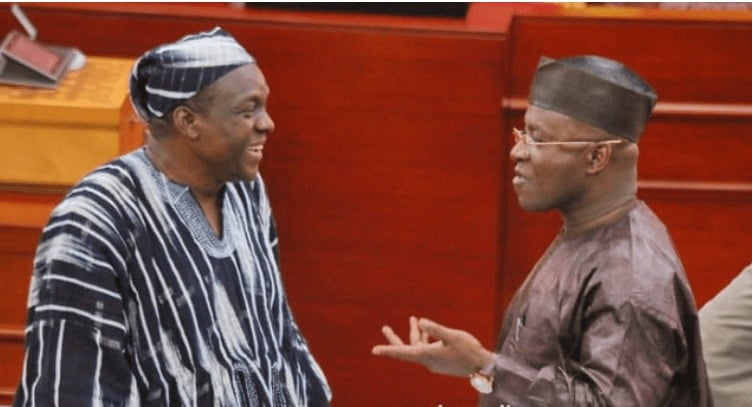
Former Majority Leader Osei Kyei-Mensah-Bonsu has voiced his strong support for the current Majority Leader, Alexander Afenyo-Markin’s decision to elevate ongoing parliamentary disputes to the Supreme Court. This development arises from a perceived breakdown in the relationship between the Majority and Minority factions within Parliament, significantly influenced by Speaker Alban Bagbin’s alignment, which Kyei-Mensah-Bonsu describes as favoring the National Democratic Congress (NDC). In an interview with Sompa FM, he emphasized that the judiciary’s intervention is now necessary to restore balance and ensure legislative processes can continue effectively. Kyei-Mensah-Bonsu’s comments reflect growing frustrations within the Majority, who feel hindered by the Speaker’s actions, necessitating judicial clarity regarding parliamentary conduct.
Kyei-Mensah-Bonsu underscored that the Supreme Court serves as the ultimate authority on legal matters, particularly when faced with what he categorically deems Speaker Bagbin’s bias. He outlined how the ruling of the Speaker has recurrently favored the opposition, thereby obstructing the Majority’s ability to perform its legislative duties effectively. He described Afenyo-Markin’s decision as a rational response to an increasingly challenging parliamentary environment, where Bagbin’s rulings have reportedly disrupted parliamentary operations and could be detrimental to the legislative process in the long run.
Criticism directed at Speaker Bagbin was straightforward; Kyei-Mensah-Bonsu articulated a clear pattern of bias in the Speaker’s decisions, which he claims primarily support the NDC, to the detriment of the Majority. He remarked that this trend is indicative of a broader issue affecting parliamentary dynamics and has contributed significantly to the frustrations felt by the Majority party members. The perception of Bagbin’s decisions as politically motivated rather than neutral has intensified discontent, prompting calls for an intervention that can provide a more balanced approach to parliamentary governance.
Reflecting upon Bagbin’s tenure as Speaker, Kyei-Mensah-Bonsu posited that it appears the Speaker has utilized his authority to promote the interests of the opposition. He reiterated that the nature of the Speaker’s rulings has become a source of aggravation within the Majority, which is increasingly feeling marginalized. This sentiment underscores a growing urgency for either a change in leadership or at least a judicial ruling that can clarify the conduct expected from the Speaker and protect the legislative process from partisan biases.
In light of this, Kyei-Mensah-Bonsu dispelled concerns regarding the principle of separation of powers, arguing that the necessity of adjudicating issues that arise in Parliament does not undermine this principle but rather reinforces the accountability and checks that are integral to a functional democratic system. By asserting that legal recourse is justified when overreach occurs, he positions the Supreme Court as a critical arbiter in resolving these disputes, asserting that lawmakers should not shy away from seeking legal clarity.
Kyei-Mensah-Bonsu concluded with a clarion call for immediate intervention to avert ongoing disruptions in Parliament. He warned that without a definitive judicial interpretation, the Speaker’s contentious rulings might perpetuate conflict and impede legislative work. His emphasis on obtaining the Supreme Court’s guidance reflects a pressing need for resolution in order to create a sustainable functioning environment within Parliament. The insistence on judicial review of parliamentary practices underscores the critical intersection of legal and political realms in managing governance in Ghana, particularly amid heightened partisan tensions.









